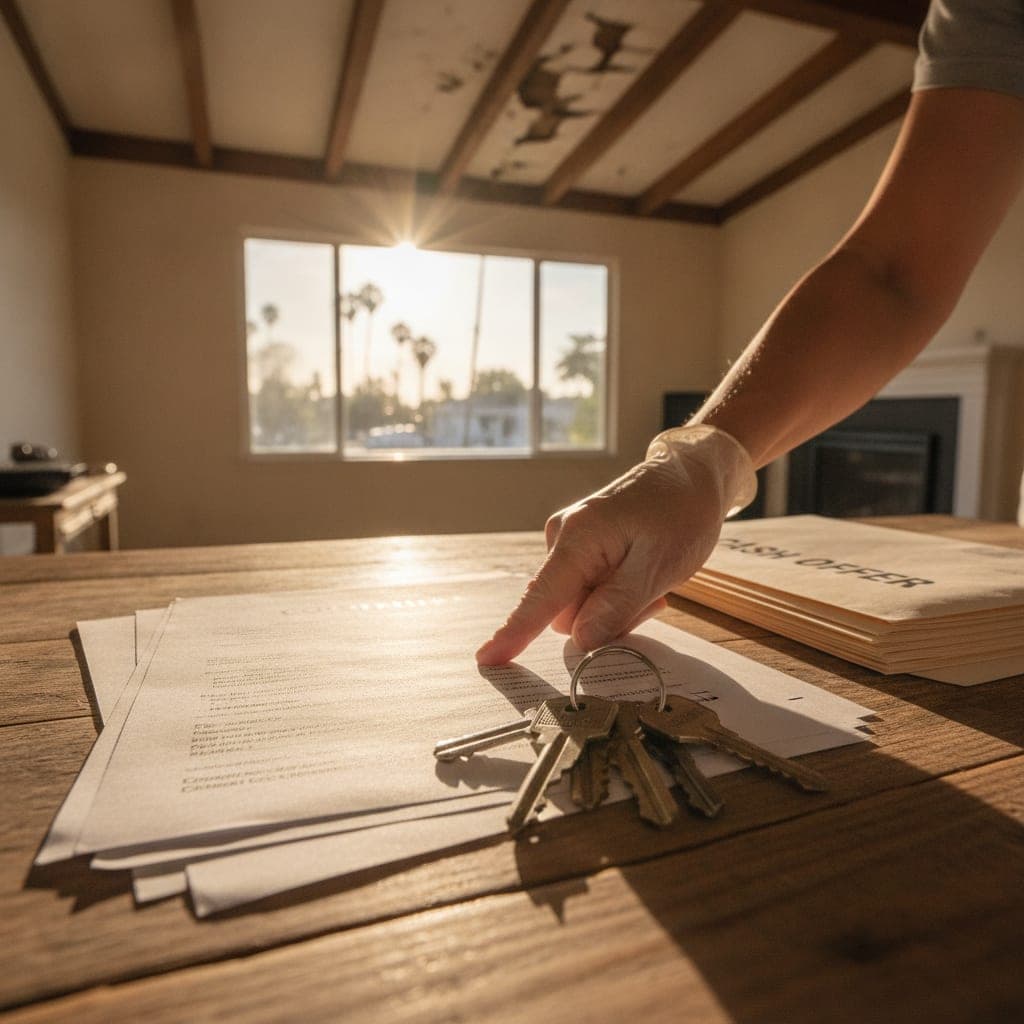

Selling the house in a California divorce. We buy for cash, close on a date you both agree, no repairs, no commissions, no agent in the middle.
The restraining order nobody warned you about
The moment a California divorce petition is filed and served, automatic temporary restraining orders take effect on both spouses. They are printed on the back of the summons, they are not something a judge decides to impose, and most people never read them.
Among other things, they bar either spouse from transferring, encumbering, or disposing of community property without the other's written consent or a court order.
The house is community property in most marriages. So selling it during a pending divorce takes one of two things:
- Both spouses agreeing in writing, which in practice means both signing the listing or purchase agreement, or
- A court order authorizing the sale
There is no third path where one spouse sells and sorts it out later. A buyer's title company will catch it, and escrow will not close on a signature that is missing.
This is the single most common reason a divorce sale stalls. It is also the easiest to plan around, because a cooperative sale needs no hearing at all. Two signatures is faster than a motion.
Community property, and what an equal split actually means
California presumes property acquired during the marriage is community property, owned equally, and the court divides the community estate equally.
Equal division applies to the community estate as a whole, not necessarily to each asset. Some real-world consequences:
- Down payment from before the marriage, or from an inheritance or gift. That contribution may be traceable as separate property and reimbursable to the spouse who made it, off the top, before the rest is split.
- Title in one name only. This decides very little on its own. A house bought during the marriage with community earnings is generally community property regardless of whose name is on the deed.
- Refinances and title changes made during the marriage. These can change the character of the property, sometimes accidentally.
Which of these applies to you is a question for your attorney with your actual documents. What matters here is that it changes the arithmetic of who nets what, so it should be settled before you agree a sale price, not after.
Who has been paying the mortgage since you separated
Between separation and sale, someone is usually covering the mortgage and someone is usually living in the house. California has a name for both sides of that.
Epstein credits: a spouse who pays community debts, such as the mortgage, from their own post-separation earnings may be entitled to reimbursement from the community.
Watts charges: a spouse who has exclusive use of a community asset, such as living in the house alone, may owe the community the reasonable value of that use.
These frequently offset each other, and neither is automatic. Both have to be raised and calculated. Keep records of every post-separation mortgage, tax and insurance payment from the date you separated, because reconstructing them later is painful and the person with the paperwork usually wins the argument.
Selling now versus a deferred sale order
California courts can order a deferred sale of the family home, keeping it temporarily and awarding exclusive use to the parent with primary custody, typically so children can stay in the same school. It is sometimes called a Duke order.
Courts weigh whether deferring is economically feasible, meaning whether the resident spouse can actually carry the mortgage, taxes, insurance and upkeep, and whether it serves the children.
Worth being honest about the cost of deferring, because it is easy to underestimate:
| Sell now | Defer the sale | |
|---|---|---|
| Equity | Split and available now | Locked up until the trigger date |
| Both names on the mortgage | Ends at close | Usually continues |
| New mortgage for the leaving spouse | Cleaner, no contingent liability | Harder, lender counts the old loan |
| Maintenance and repair disputes | Ends at close | Continues for years |
| Market risk | Priced today | Carried by both, resolved later |
The contingent-liability point catches people out. While both names remain on the loan, the spouse who moved out is still legally on the hook, and a future lender will count that payment against them even though someone else is making it. That can be the difference between qualifying for a new home and not.
The capital gains timing nobody mentions
Two people who file jointly can exclude up to $500,000 of gain on the sale of a principal residence, subject to the ownership and use tests. Two single filers can exclude up to $250,000 each.
Those add to the same number, so the exclusion itself is not usually the problem. The timing is. Once one spouse has moved out, the use test starts to matter for them, because it generally requires living in the home for 2 of the last 5 years. A sale that drags on for years after separation can quietly cost the departed spouse their half of the exclusion.
There are provisions that help when a divorce or separation agreement governs the situation, and this is genuinely a question for a CPA rather than for us. The reason it belongs on this page is simple: the longer a divorce sale is deferred, the more likely tax becomes a factor that nobody priced in.
Your timeline with My Home Sold
Step 1: Both spouses on the call
We would rather talk to both of you, or to both attorneys, from the start. A cash offer only helps if everyone agrees it is fair.
Step 2: Written offer in 24 hours
One number, in writing, that both sides and both attorneys can look at. No showings, no strangers walking through, no negotiating an offer twice.
Step 3: Both signatures, or the court order
We work with your attorneys on the paperwork. If a court order is needed rather than mutual consent, we can wait for it.
Step 4: Close on an agreed date
Escrow pays the mortgage and any liens, and splits the proceeds according to your agreement or the court's order. We do not decide the split.
Your options compared
| Factor | Traditional listing | One spouse buys the other out | My Home Sold |
|---|---|---|---|
| Time to close | 60–120 days | 30–60 days, subject to qualifying | 7–14 days |
| Needs both signatures | Yes | Yes | Yes |
| Showings and strangers in the house | Yes, repeatedly | No | No |
| Repairs demanded by a buyer | Likely | No | None |
| Removes both names from the mortgage | Yes | Only the departing spouse | Yes |
| Certainty of the number | Offer can fall through | Depends on qualifying | Fixed at signing |
The tradeoff, plainly: we buy below retail, usually 10–20% depending on condition and market. If you can both cooperate through a 60 to 120 day listing, the house shows well, and neither of you needs the money quickly, a traditional listing will net more. The cash route earns its discount when the sale itself has become the argument, when repairs are not happening because nobody will pay for them, or when both of you simply need it finished.
Compare the routes in our guide to selling a house fast in California.
Sell your California house the easy way
Get a no-obligation cash offer on your California home in 24 hours. No fees, no commissions, no obligation to accept. Get your free cash offer or call (714) 909-1081.
Common questions
Questions people ask about this
- Do both spouses have to agree to sell our California house in a divorce?
- In almost all cases yes, California community property requires both signatures on any sale of a marital home until a court order or final judgment says otherwise. If one spouse refuses, the other can petition the court to compel the sale. We've worked sales like this from both sides.
- How are proceeds split when we sell during divorce?
- Per whatever your settlement agreement or court order specifies. Most California divorcing couples split community-property proceeds 50/50 after paying off the mortgage and closing costs. The title company holds funds in escrow and disburses as instructed.
- Can we sell before the divorce is final?
- Yes. Most California divorcing couples sell during the divorce, not after. The proceeds typically go into a joint account or escrow holdback until the final settlement is signed. Selling early reduces holding costs (mortgage, taxes, utilities) that both spouses are paying anyway.
- What if my spouse and I disagree on the listing price?
- A cash offer eliminates the disagreement, there's one number, take it or leave it. Many divorcing couples use our written offer as a starting point because it removes the price-negotiation conflict. If you accept, we close. If you don't, you've lost nothing.
- Can you handle the sale if we have a restraining order between spouses?
- Yes. We never need both spouses in the same room. Documents are signed via mobile notary independently, and the title company handles all communication. Many of our divorce sales never have the spouses meet face to face.
Written by
Adrian HernandezCEO/Owner, My Home Sold
Adrian Hernandez founded My Home Sold in 2015 and has led it through more than 900 direct home purchases across Southern California. He has appeared on FOX 11 Good Day LA discussing the shift in the Southern California market and what it means for homeowners whose listings are not moving.
More about AdrianReady to Get Started?
Contact us today to learn how we can help you.