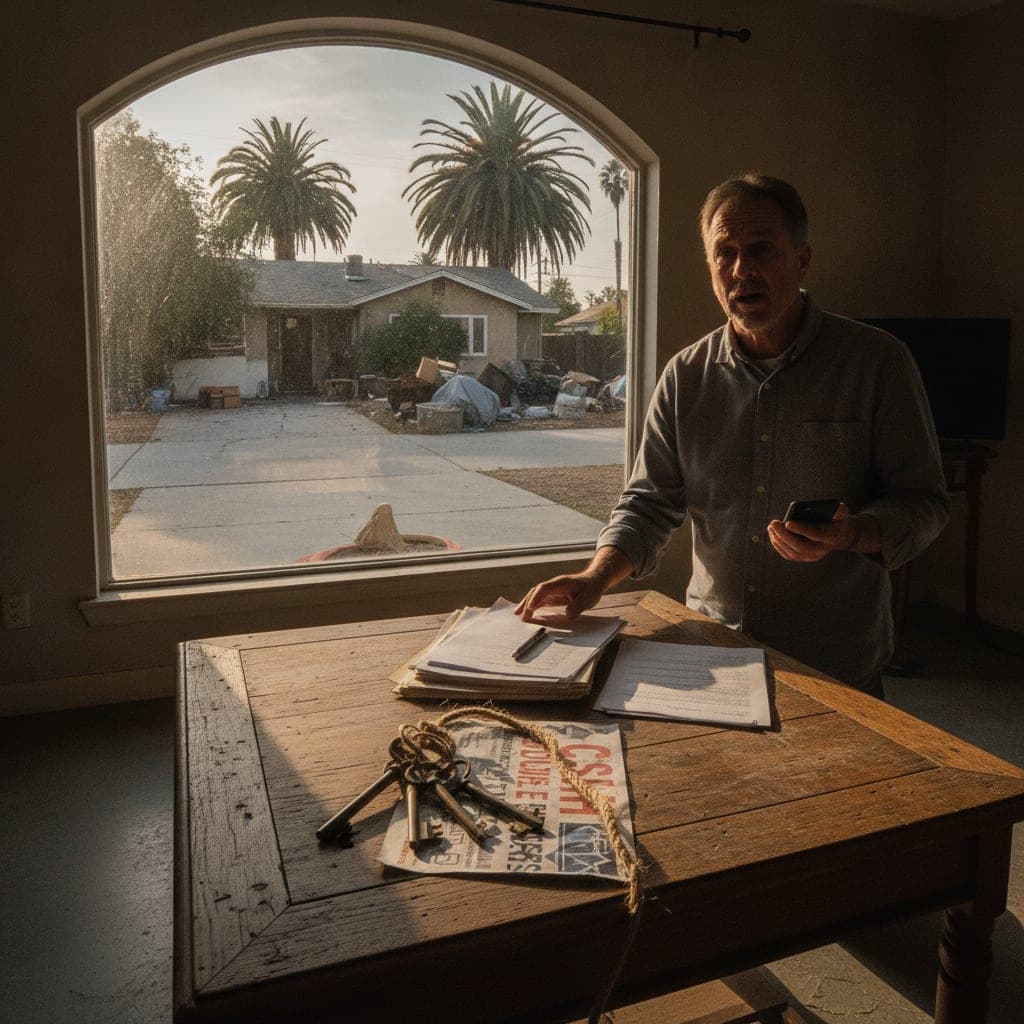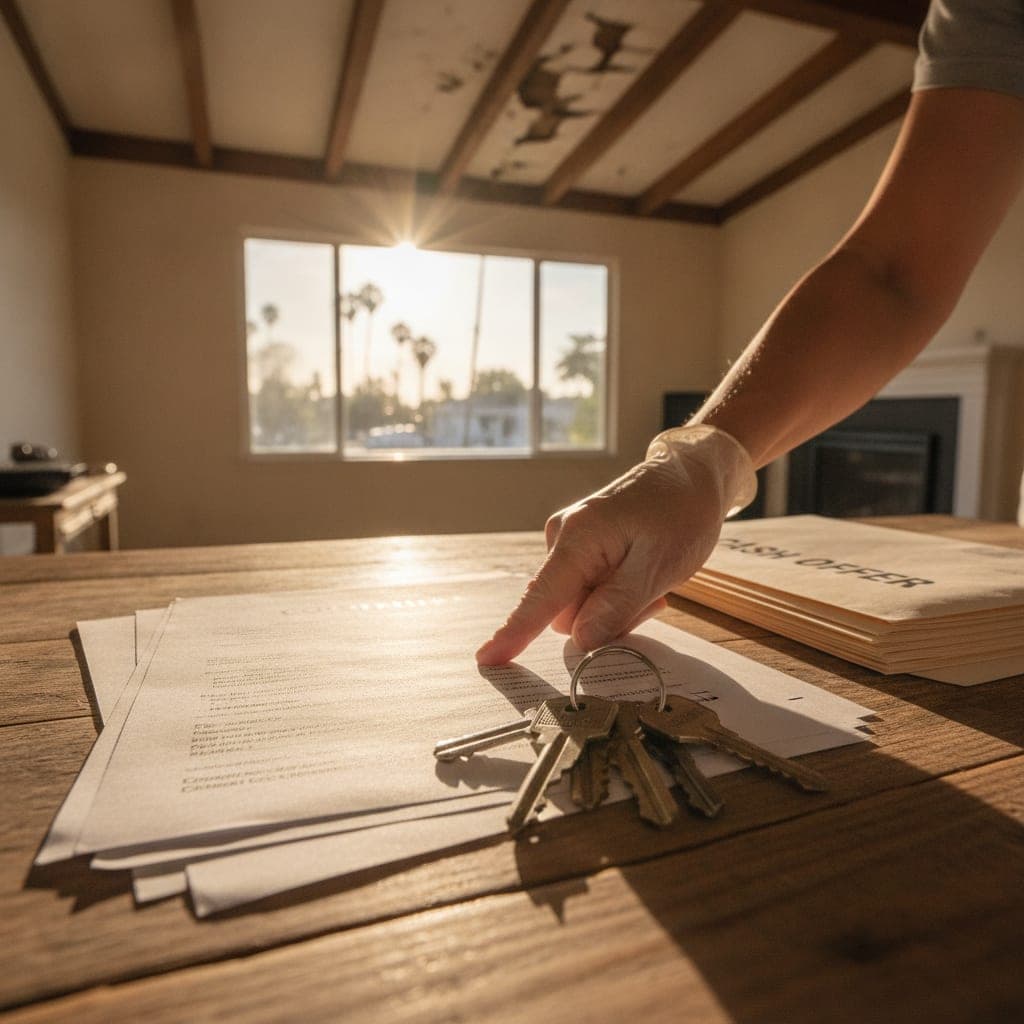
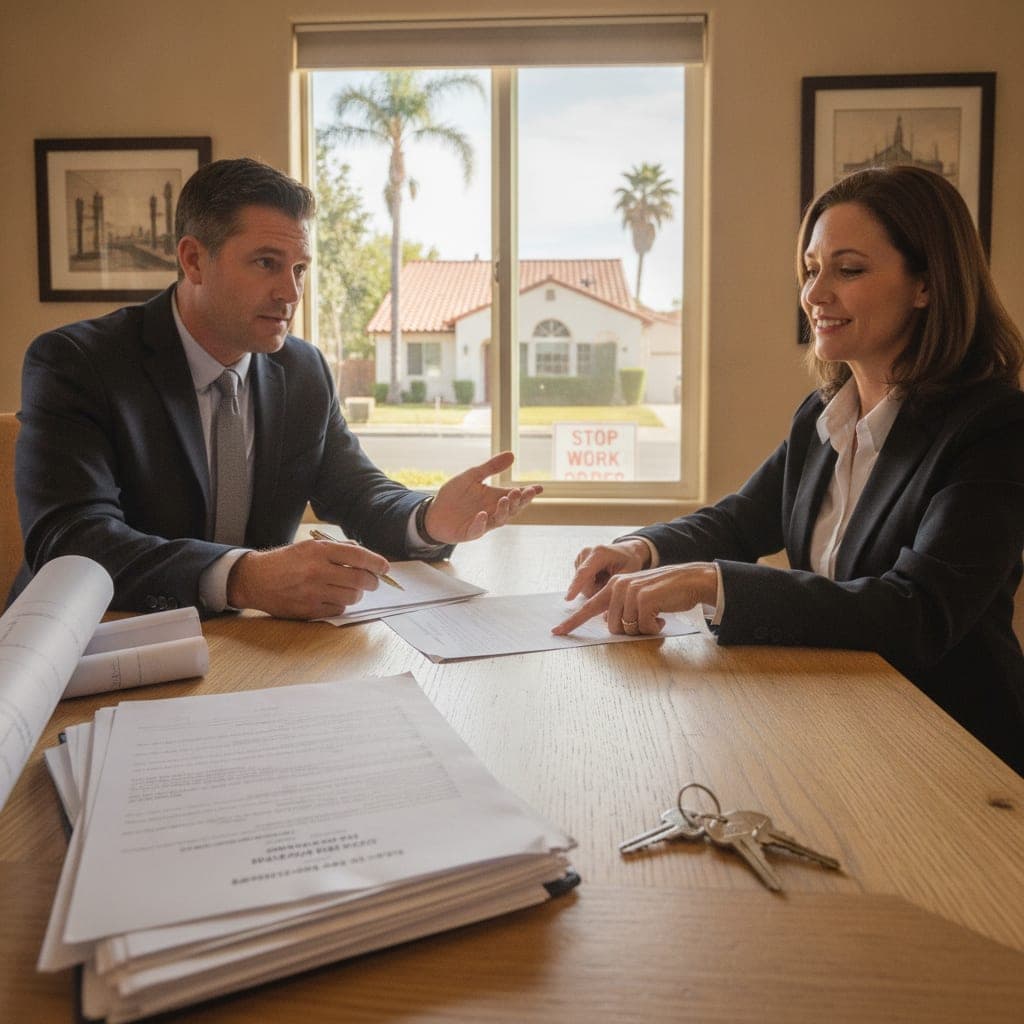
We buy houses cited for unpermitted work or code issues. Skip the permit process, the contractors, and the agent commissions. Fair cash offer in 24 hours, close in as little as 7 days.
What a code violation does to a California sale
A code violation is not a lien on day one. It starts as a notice from the city or county telling you to correct something by a date. Nothing is recorded, nothing attaches to title, and you can sell the house that afternoon if you want to.
What changes over time is the escalation. Depending on the jurisdiction, an uncorrected violation can turn into daily administrative fines, a recorded notice against the property, an abatement performed by the city at your expense, or a court-appointed receiver.
The common ones we see on California files:
- Unpermitted additions, garage conversions and ADUs
- Expired or abandoned building permits, where work was started and never finalled
- Substandard conditions under Health and Safety Code section 17920.3, which covers everything from faulty wiring to inadequate sanitation
- Defensible-space and vegetation citations
- Red-tagged structures declared unsafe to occupy
The first thing to establish is not what the violation is. It is how far along the escalation ladder your file has climbed, because that determines your actual deadline.
Abatement liens, and the receivership nobody expects
Two escalations change the math, and most owners have not heard of the second one.
Abatement. If you do not correct the condition, the jurisdiction can do the work itself and bill you. Under the Health and Safety Code, those costs can be made a special assessment against the property and collected like property taxes. That is the point at which a code problem becomes a title problem, because the assessment now has to be cleared at closing.
Receivership. For substandard properties, a court can appoint a receiver to take control of the building and bring it into compliance. The receiver borrows against the property to fund the work, and the certificates issued to fund it can take priority over existing liens, including your mortgage.
That priority is the part worth understanding. A receivership can consume the equity in a house while the owner still holds title, and it is the outcome that turns a fixable citation into a total loss. It is not common, but it is the reason not to let a substandard-condition case sit for years.
If you have been served with anything mentioning a receiver, stop reading marketing pages and call a real estate attorney today.
Legalizing unpermitted work, and what it really costs
Retroactive permitting is a real path, and sometimes the right one. It is also routinely underestimated, because the cost is not the permit fee.
To legalize unpermitted work, a California jurisdiction will generally want the work brought to current code, not the code that applied when it was built. In practice that means:
- Opening finished walls and ceilings so an inspector can see framing, wiring and plumbing
- Bringing electrical and plumbing up to today's standards, not 1985's
- Title 24 energy compliance on the affected areas
- Structural calculations, and sometimes a stamped engineer's report
- Fire separation and egress requirements for converted garages and ADUs
Which is how a $400 permit becomes a $40,000 job. And unlike a renovation you chose, none of it shows up as new kitchen or new bath when you sell.
One genuinely useful exception: California has narrowed local enforcement against certain unpermitted accessory dwelling units, allowing owners to delay correction until the unit can be inspected for health and safety rather than being forced into immediate demolition. If your violation is an unpermitted ADU, ask your jurisdiction specifically about this before you assume you have to tear it out. It has saved sellers we have worked with a great deal of money.
You still have to disclose it
Selling as-is does not switch off California's disclosure duties, and this catches people.
On most residential sales you complete a Transfer Disclosure Statement, and known code violations, unpermitted work and open enforcement cases belong on it. "As-is" governs who pays to fix things. It does not govern what you have to tell the buyer.
Our position on this is simple and it is in your interest as much as ours: disclose everything, in writing, up front. We price the violation into the offer rather than discovering it during escrow and asking to renegotiate. A seller who hides an unpermitted conversion is not protecting the deal, they are creating a claim against themselves that outlives the closing.
Why retail buyers walk and we don't
A retail buyer is usually financing. Their lender orders an appraisal, and an appraiser who sees an open permit, a red tag or an obviously unpermitted addition will condition the loan on it being corrected before funding.
That produces the loop sellers get stuck in: the buyer cannot close until the work is done, you cannot afford the work until the house sells, and the buyer's rate lock expires while everyone argues. Two or three cycles of that and the listing goes stale.
We pay cash, so there is no appraiser and no lender condition. We take the violation with the house and handle the correction after closing, either by permitting it, removing it, or selling it on with the same disclosure you gave us.
Your timeline with My Home Sold
Step 1: Send us the notice
The citation, the correction notice, or the inspection report. What matters is which agency issued it and what stage it has reached.
Step 2: We check the record
We pull the county record and the jurisdiction's case file to see whether anything has been recorded, and whether abatement costs have already been assessed.
Step 3: Written offer in 24 hours
The violation is priced in openly. You see what we assumed it will cost to correct, so you can judge whether the number is fair.
Step 4: Close, and it becomes our problem
Recorded assessments are paid from escrow. The open case transfers with the property.
Your options compared
| Factor | Traditional listing | Correct it first, then list | My Home Sold |
|---|---|---|---|
| Time to close | 60–120 days, if it survives the appraisal | Months, plus permit and inspection cycles | 7–14 days |
| Out of pocket before closing | Repairs the buyer demands | The full correction cost, up front | $0 |
| Survives a lender's appraisal | Often not | Yes | Not applicable, we pay cash |
| Fines accruing meanwhile | Yes | Yes, until signed off | Stop at close |
| Who carries the risk that it costs more than expected | You | You | Us |
The tradeoff, plainly: we buy below retail, usually 10–20% depending on condition and market, and on a violation file the discount reflects what we expect the correction to cost. If the violation is small, you have the cash to clear it, and the house is otherwise retail-ready, correcting it and listing normally will net you more. We will say so.
Where the cash route earns its discount is when the correction is larger than your access to capital, when the case is escalating, or when you have already had one financed buyer walk.
Compare the routes in our guide to selling a house fast in California, or see how we handle houses in any condition.
Sell your California house the easy way
Get a no-obligation cash offer on your California home in 24 hours. No fees, no commissions, no obligation to accept. Get your free cash offer or call (714) 909-1081.
Common questions
Questions people ask about this
- Will my California city block the sale because of code violations?
- Usually no. Code violations slow buyers but don't freeze the title. Some cities require disclosure of open enforcement actions on the closing documents, but the sale proceeds. The exception: properties with active liens for unpaid abatement costs, those liens get paid out of escrow at closing, the same as any other lien.
- I have an unpermitted addition. Will you still buy?
- Yes. We've bought dozens of California houses with unpermitted additions, conversions, or ADUs. Either we permit them post-close, remove them, or sell with disclosure to a buyer who values them as-is. Don't hide it, disclose it on the TDS and let us factor it into the offer.
- Do I have to fix the violations before selling to you?
- No. We buy code-violation properties exactly as they are. Don't spend money on permits, abatement, or restoration before talking to us, those costs are usually higher than the discount we apply, and you might be paying twice.
- What if I don't know whether my house has open violations?
- Most California cities let you check online by address. We'll also pull the permit and code-enforcement history when we underwrite the offer. If there's something open, we'll tell you what we found. No surprises either direction.
- Are there code violations you won't buy?
- Rarely. We've walked from properties with structural condemnation that wasn't economically curable, and a couple where the lien stack exceeded the home's value. Everything else, unpermitted work, expired permits, abatement orders, red tags, has been buyable at the right number.
Written by
Adrian HernandezCEO/Owner, My Home Sold
Adrian Hernandez founded My Home Sold in 2015 and has led it through more than 900 direct home purchases across Southern California. He has appeared on FOX 11 Good Day LA discussing the shift in the Southern California market and what it means for homeowners whose listings are not moving.
More about AdrianReady to Get Started?
Contact us today to learn how we can help you.