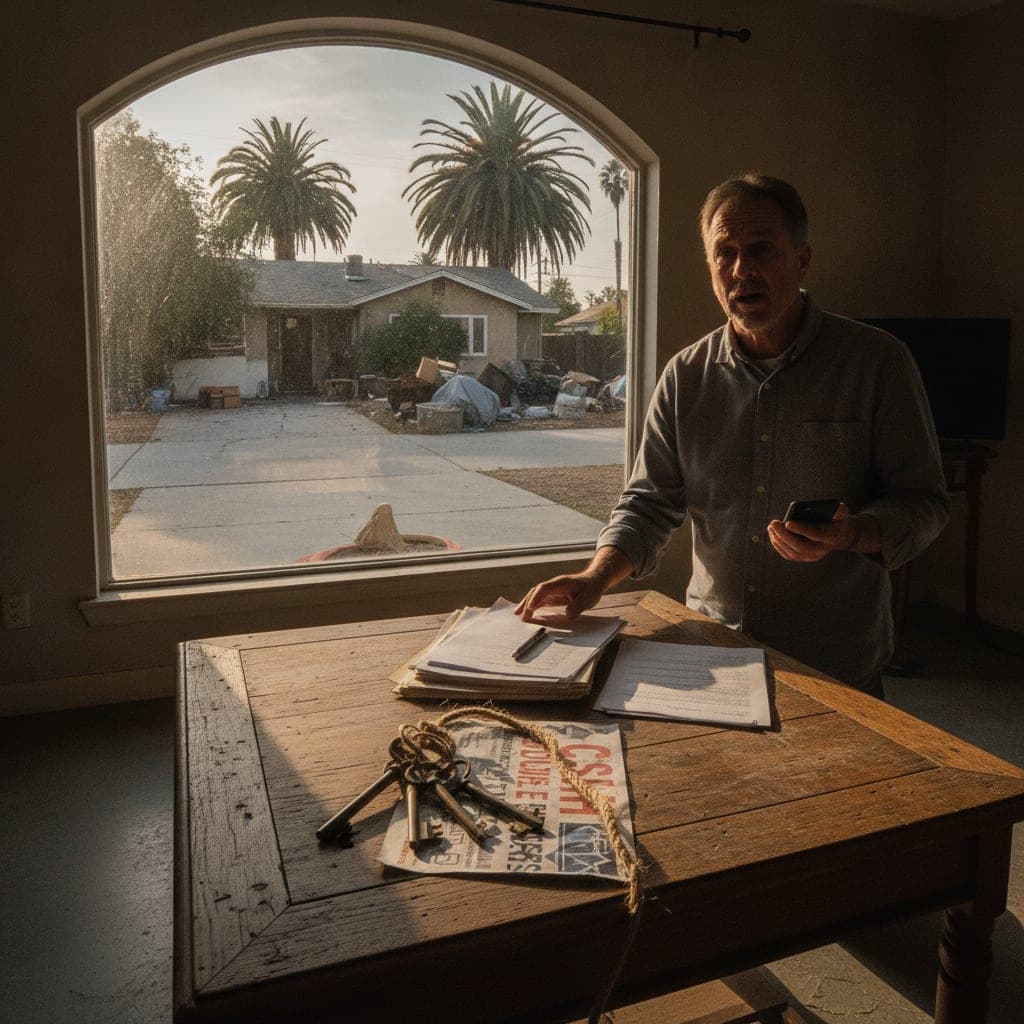

Own California property but live somewhere else? We buy remote sellers' houses for cash. No trips, no repairs, no commissions. Offer in 24 hours, close in as little as 7 days.
California withholds from your sale proceeds
The surprise on nearly every out-of-state closing statement, and the reason to read this section before you budget your net.
California requires withholding on the sale of real property located in the state. The standard rate is 3 1/3% of the total sale price, not of your gain. It is withheld at closing and remitted to the Franchise Tax Board, reported on Form 593.
On a $600K sale that is $20,000 held back at closing.
This is a prepayment, not a tax. You reconcile it when you file a California return for the year, and if too much was withheld you get it back. But it comes out of the wire on closing day, so the money is not available for whatever you planned to do with it that month.
Several exemptions and elections exist, and they are worth asking your escrow officer about specifically:
- The property qualified as your principal residence under the federal exclusion rules
- The total sale price is $100,000 or less
- You are selling at a loss, or with zero gain
- You can elect an alternative calculation based on actual gain rather than the flat 3 1/3% of price, which usually withholds far less
That last one is the one people miss. On a modest gain, electing the gain-based calculation instead of the flat rate can be the difference between $20,000 held and a small fraction of it. Escrow will hand you Form 593 to certify. Read it rather than signing it blind, and talk to your tax preparer before closing rather than after.
Signing from another state
You will not be signing electronically for the deed, and this trips people up who assume remote closing means fully online.
California has been slow to authorize remote online notarization. Legislation exists but implementation has been pushed well into the future, so for practical purposes today a California deed still needs a traditional, in-person notarial act.
That does not mean flying out. The normal routes:
- Mail-away closing. Escrow couriers the package to you, you sign before a notary local to you, and you courier it back. Completely routine, and escrow companies do it constantly. Build 3 to 5 days into the timeline for the round trip.
- Mobile notary. They come to your home or office wherever you are.
- Power of attorney. Someone in California signs for you. This needs setting up in advance, and the title company must approve the POA before closing. Do not assume a general POA from an estate plan will be accepted; ask early.
Whichever route, tell escrow at the start that you are out of state. A mail-away arranged on day two is invisible; one discovered on the day of signing costs a week.
Being non-resident does not exempt you from California tax
A common and expensive misconception: that living in Texas or Nevada means California has no claim on the sale.
Gain from the sale of California real property is California-source income. Non-residents are taxed by California on California-source income, and a sale generally requires you to file a California non-resident return for that year. The withholding above is the mechanism that ensures they collect.
Your home state may also tax the gain, with a credit typically available for tax paid to California, but the interaction depends entirely on which state you live in.
This is genuinely a question for a CPA who handles multi-state returns, and it is worth the consultation fee before you sell rather than the following April. What matters here is only this: do not plan your net on the assumption that California is not involved.
What remote ownership actually costs
Most out-of-state owners underestimate the drag, because it arrives as small amounts rather than a bill.
| Line | Typical |
|---|---|
| Property taxes on a $600K house | $550–$650 a month |
| Insurance, higher if vacant | $150–$400 a month |
| Property manager, if tenanted | 8–10% of rent |
| Landscaping and basic upkeep | $100–$200 a month |
| A trip out to deal with something | $600–$1,500 each |
The trips are the part nobody budgets. Two or three round trips to meet a contractor, handle a tenant, or sign something turns into thousands of dollars and a week of leave, and it recurs.
If the house is empty, read our vacant property guide as well. The insurance vacancy clause in particular catches remote owners hardest, because nobody is there to notice a problem early.
Repairs you cannot supervise
The structural disadvantage of selling a California house from 1,500 miles away is that you cannot see the work.
Listing usually means preparing the property: clearing it, cosmetic work, and then whatever the buyer's inspection turns up. Managed remotely, that means hiring contractors you have not met, on the recommendation of someone you also have not met, and paying against photographs.
It goes wrong in predictable ways. Work is slower with nobody checking. Scope grows. A $4,000 job becomes $9,000 and you cannot judge whether that is fair. And the whole time the carrying costs above keep running.
Then the inspection contingency arrives and asks for another round of it.
That asymmetry, not the commission, is the real reason remote sellers often do better with a cash sale than the raw numbers suggest. A discount you can see beats an open-ended repair budget you cannot supervise.
Your timeline with My Home Sold
Step 1: Call from wherever you are
Address and rough condition. You do not need to have seen it recently.
Step 2: We go and look
Our team does the walkthrough. You do not fly out, and you do not need to send anyone.
Step 3: Written offer in 24 hours
Contents included, so nothing needs clearing. No repairs, no cleanout, no staging.
Step 4: Mail-away closing
Escrow couriers the package, you sign in front of a local notary, funds wire to your account. You never come to California.
Your options compared
| Factor | List remotely | Rent it out | My Home Sold |
|---|---|---|---|
| Trips required | Usually 1–3 | Ongoing | None |
| Repairs before sale | Yes, managed remotely | Make-ready, managed remotely | None |
| Time to money | 60–120 days plus prep | Monthly, minus management | 7–14 days |
| CA withholding applies | Yes | Not applicable | Yes, same rules |
| Who deals with problems | You, remotely | A manager, at 8–10% | Nobody, it is sold |
The tradeoff, plainly: we buy below retail, usually 10–20% depending on condition and market. If the house is in good shape, you have someone local you trust, and you are not in a hurry, listing it will net you more even after the trips. We will say so on the call.
The cash route earns its discount when the property needs work you would be managing by phone, when it has been sitting empty, or when the honest cost of another year of remote ownership is higher than the gap.
Compare the routes in our guide to selling a house fast in California.
Sell your California house the easy way
Get a no-obligation cash offer on your California home in 24 hours. No fees, no commissions, no obligation to accept. Get your free cash offer or call (714) 909-1081.
Common questions
Questions people ask about this
- Can I sell my California property without traveling there?
- Yes. Most of our out-of-state sellers never set foot in California during the sale. Tour is coordinated with a local contact (property manager, neighbor, friend), documents are signed via mobile notary in your state, and the wire hits your bank account on closing day.
- How does notarization work when I'm in another state?
- A mobile notary comes to your home or office anywhere in the U.S. The notary verifies your ID, watches you sign, and notarizes the deed. The notarized packet goes overnight to the title company in California, who records it the next day. We pay the mobile notary fee.
- What if I live overseas?
- Selling from overseas works but takes longer. Documents need to be notarized at a U.S. embassy or consulate (or by a local notary with apostille certification, depending on the country). Mail times stretch the timeline to 30–45 days. The fastest path is granting power of attorney to a U.S.-based representative who can sign on your behalf.
- Who arranges the property tour if I'm not there?
- You give us a contact, neighbor, property manager, real estate agent friend, family member with a key. We coordinate with them directly. If the property is vacant and you have nobody local, we'll work with a lockbox arrangement and your verbal authorization.
- How long does an out-of-state California sale take?
- 7–21 days for U.S.-based sellers. 30–45 days for overseas sellers. The extra time vs. an in-state sale is mostly mailing the deed packet, the actual escrow and title work moves at the same pace.
Written by
Adrian HernandezCEO/Owner, My Home Sold
Adrian Hernandez founded My Home Sold in 2015 and has led it through more than 900 direct home purchases across Southern California. He has appeared on FOX 11 Good Day LA discussing the shift in the Southern California market and what it means for homeowners whose listings are not moving.
More about AdrianReady to Get Started?
Contact us today to learn how we can help you.