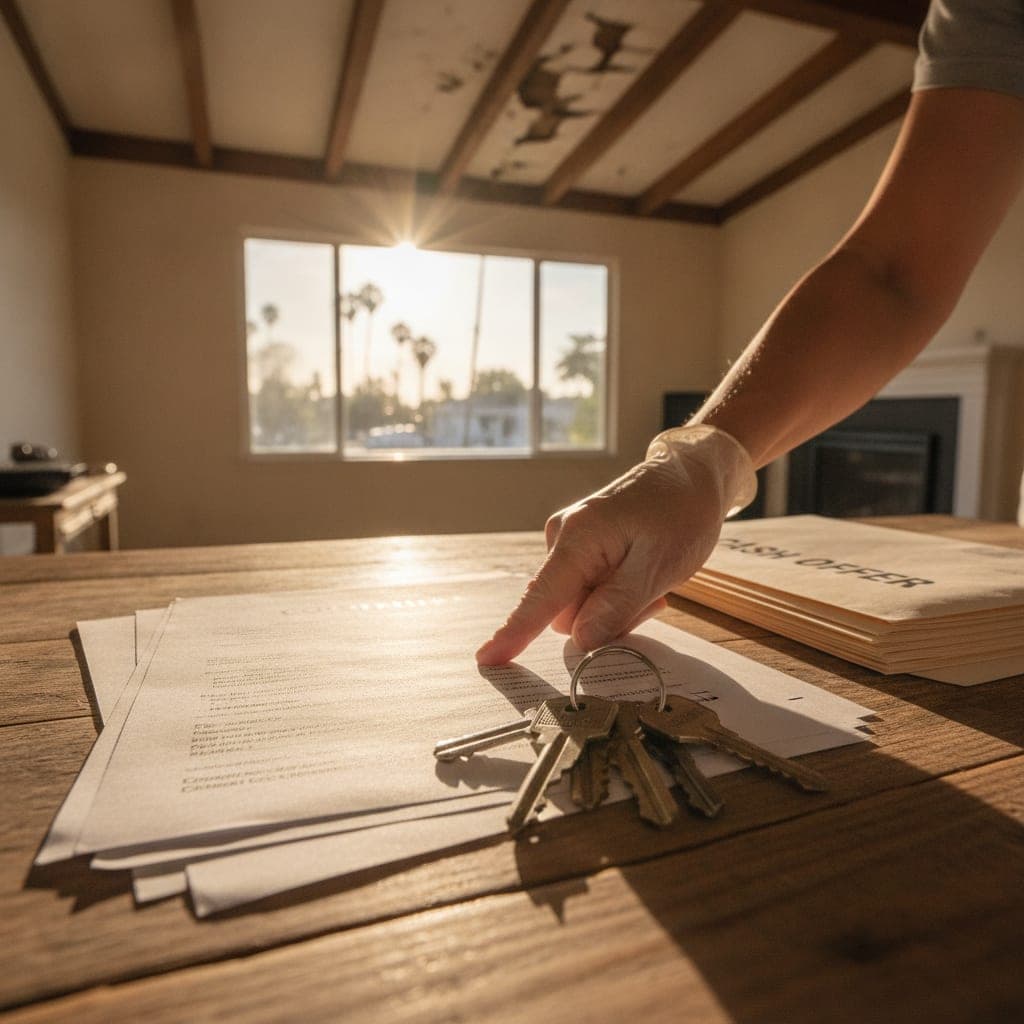
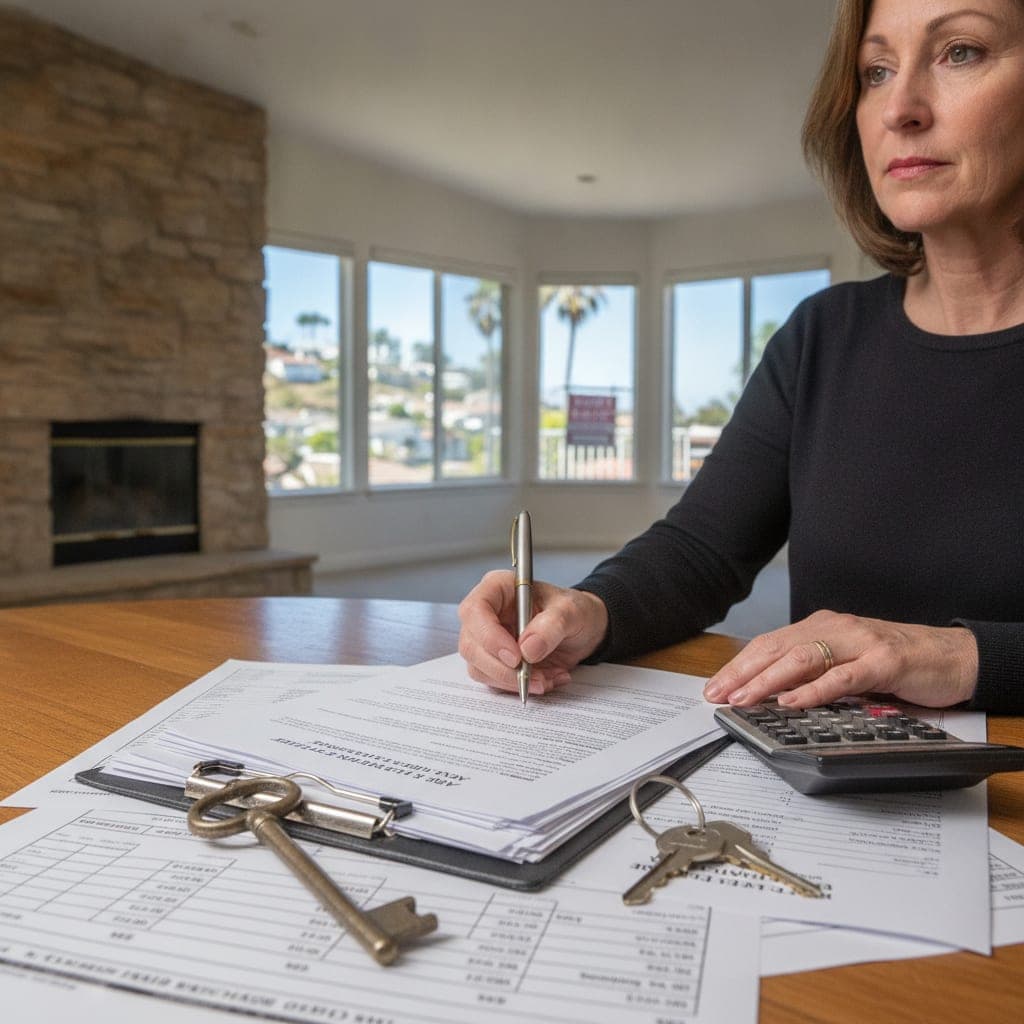
If you sell a house as-is in California, expect to give up 8 to 18 percent of fair market value compared to a fully prepped listing. The reason is not punishment for skipping repairs. It is a rational discount that buyers and lenders apply to compensate for risk, repair costs, and a smaller buyer pool. This guide walks through how much you actually lose when you sell as-is, the line items that drive that number, and the situations where the as-is math still nets you more than a retail listing.
What "as-is" actually means in California
In California, every residential resale is technically "as-is" once the standard CAR purchase contract is signed. What sellers usually mean by "selling as-is" is something narrower: no pre-list repairs, no concessions for items found at inspection, no cleaning, no staging. The buyer gets the property in its current condition for the agreed price.
It is important to know what as-is does not exempt you from. You still owe California's Transfer Disclosure Statement (TDS), Natural Hazard Disclosure (NHD), seller property questionnaire, lead-based paint disclosure for pre-1978 homes, and the AB 38 wildfire-zone disclosure where applicable. "As-is" is about repairs, not about disclosures. Those are mandatory regardless. We cover the full disclosure stack in how to sell my house fast in California.
The headline number: 8 to 18 percent
Across thousands of California transactions, as-is sales transact at a measurable discount versus comparable fully prepared listings. The range varies by condition and market:
| Property condition | Typical as-is discount | Typical California dollar impact (on $750K ARV) |
|---|---|---|
| Cosmetic only (paint, flooring, deep clean) | 5 – 8% | $37,500 – $60,000 |
| Mid-grade deferred maintenance | 10 – 15% | $75,000 – $112,500 |
| Major systems failing (roof, HVAC, plumbing) | 15 – 22% | $112,500 – $165,000 |
| Distressed (fire, mold, hoarding, code) | 25 – 35% | $187,500 – $262,500 |
Those numbers are the gap between what a fully prepped listing would fetch and what the same house transacts for in as-is condition. Whether that gap is "a loss" depends on what you would have spent to close it. We get to that line item below.
Why buyers discount as-is sales
A buyer paying retail price for a renovated home is buying a finished product. A buyer of an as-is property is taking on a project, with three categories of cost the seller no longer carries:
- Visible repairs. Roof patches, peeling paint, cracked tile, anything they can see, they will price.
- Hidden repairs. Plumbing under slabs, wiring behind walls, foundation issues. They build a contingency line into their offer.
- Time and hassle. Months of contractors, permits, and decision-making. That has a number too.
The sum of those three lines is the as-is discount. A rational buyer will pay your fully-prepped value minus those costs minus a margin for taking on the work themselves. That is exactly the math behind every cash offer from an investor.
The repair-cost line in detail
Most sellers underestimate California repair costs by 30 to 50 percent. A few common items, with realistic 2026 numbers from Southern California contractors:
- Composition roof tear-off and replace, 2,000 sq ft: $14,000 – $22,000
- Whole-house repipe (copper to PEX): $10,000 – $18,000
- Panel upgrade (100A to 200A): $4,500 – $7,500
- Sewer line replacement: $8,000 – $20,000
- Slab leak repair: $4,000 – $9,000
- Termite tent and treatment: $2,500 – $5,500
- Foundation crack repair (typical): $8,000 – $25,000
- Mold remediation (one room): $3,500 – $8,000
A 30-year-old California home with deferred maintenance often carries $60,000 to $120,000 of latent repair cost the seller never sees on a day-to-day basis. The buyer sees it during inspection. Their offer reflects it.
The buyer-pool effect
A fully prepared listing in California reaches every buyer category: first-time buyers using FHA or VA, conventional buyers, investors, cash buyers. An as-is listing typically reaches only the last two, and often only investors. That collapses the buyer pool from roughly 100 percent of the market to perhaps 15 to 25 percent. A smaller pool means less competition, fewer multiple-offer scenarios, and lower offers on average. This is the second major component of the as-is discount, separate from the repair number.
For properties that look fine cosmetically, simple staging and a deep clean can recover access to the broader buyer pool, and that is sometimes worth doing. For properties with structural, system, or condition issues that an FHA appraiser will flag, the buyer pool collapse is unavoidable.
The financing constraint
FHA, VA, and USDA loans require the property to meet minimum property standards: working systems, no peeling lead-paint, intact roof, no major safety issues. A property that fails those standards cannot be purchased with those loan products. That eliminates roughly 30 to 40 percent of California buyers right there.
Conventional loans are more flexible but still require the lender's appraiser to sign off. A property with major issues will either appraise low or get flagged for repair before closing. Either outcome forces a price renegotiation or a repair credit, which is itself a hidden as-is discount.
Cash buyers do not have these constraints, which is why most distressed-condition properties in California ultimately sell to cash buyers. We cover the cash-vs-financed comparison on we buy houses as is.
What you save selling as-is
The as-is discount is real, but so are the costs you avoid:
- Repair budget. Whatever the buyer would have priced into their offer, you do not actually spend.
- Project management time. Coordinating contractors, permits, and inspections takes 80 to 200 hours over three months for a typical California prep.
- Carrying costs during prep. Mortgage, taxes, insurance, utilities, typically $4,000 to $8,000 per month in SoCal.
- Cosmetic prep. Paint, staging, professional cleaning, landscaping. Usually $5,000 to $15,000.
- Pre-list inspections. Termite, sewer, roof, $800 to $2,000.
- Repair credits negotiated post-inspection. Usually $5,000 to $20,000 even on prepared homes.
- Concessions. Closing-cost help, rate buy-downs, home warranty. $5,000 to $15,000 in current market.
For a typical California prep, those line items total $35,000 to $80,000. That is the savings side of the as-is ledger. Whether the as-is discount is more or less than the savings depends on the specific property.
Three California examples
Example 1: cosmetic-only home in Orange County
- Fully prepped value: $1,100,000
- Required prep: $18,000 paint, flooring, deep clean, light landscaping
- Carrying costs (60 days): $9,000
- Net retail outcome (after 6% commission, 1.5% closing, $8K repair credit): $987,500
- As-is cash offer: $945,000
- As-is loss: $42,500 (3.9% of value)
For cosmetic-only homes the as-is discount is usually small enough that the seller's preference (hassle vs. dollars) decides the call.
Example 2: deferred-maintenance home in Riverside
- Fully prepped value: $625,000
- Required prep: $52,000 (roof, HVAC, paint, flooring, kitchen refresh)
- Carrying costs (4 months): $14,000
- Net retail outcome (after commissions, repair credits, concessions): $498,000
- As-is cash offer: $475,000
- As-is loss: $23,000 (3.7% of value), but seller saved $66,000 in repair and carrying costs
In this case the as-is route nets the seller more than retail because the repair budget is high relative to the discount.
Example 3: distressed property in San Bernardino
- Fully prepped value: $480,000
- Required prep: $135,000 (foundation, roof, full system replacement, mold)
- Most retail buyers cannot finance the property as-is at all
- As-is cash offer: $295,000
- As-is loss vs. theoretical fully-prepped value: $185,000 (38%), but the seller did not have the $135,000 to spend or 9 months to manage the project
For distressed properties the as-is route is often the only realistic exit. The "loss" is theoretical because the alternative was not actually available.
When as-is nets you more
The as-is path beats retail in five recurring situations:
- The repair budget exceeds 8 percent of value. The math just works.
- You do not have repair capital. Selling at retail price requires fronting tens of thousands in prep. If that money is not available, as-is is the path.
- Your timeline is short. Foreclosure auctions, job-related relocations, and divorce settlements often cannot wait 90 days.
- You have inherited a property out of state. Managing a California probate sale from across the country is a full-time job. The as-is discount is often less than the cost and stress of remote project management.
- The property has condition issues a retail buyer's lender will not accept. Some properties simply cannot transact at retail pricing because no qualifying buyer can finance them.
When prep is worth it
Spending money to prep a house pays off when:
- The required prep is mostly cosmetic and under $25,000
- You have time (60 to 120 days) before you need to close
- You have the cash to fund prep without borrowing
- The market in your zip is hot enough to attract multiple offers
- The property is in a desirable buyer-pool segment (good schools, walkable, low days-on-market)
Under those conditions, $20,000 of paint and floors can drive $80,000 of additional sale price. The leverage is real. The trick is matching the prep level to the property and not over-improving for the neighborhood.
How to limit the as-is discount
If you are committed to selling as-is, a few moves narrow the discount:
- Disclose everything up front. Buyers discount the unknown more than the known. A clear disclosure with photos and inspection reports lets them price accurately rather than defensively.
- Get one or two pre-list inspections. Sewer, roof, termite. Buyers offer more on properties where the surprises are already on the table.
- Get multiple cash offers. Three offers usually produces a 10 to 20 percent spread. The top of that spread is what your house is actually worth as-is.
- Vet the buyer. A higher gross offer from a flaky buyer who will renegotiate at day 14 is worth less than a clean offer from a reputable cash buyer.
- Avoid wholesalers. They tie up the property and shop the contract. Their price has an assignment fee baked into it that you pay.
- Compare to a real retail-net number, not a wishful one. Use comps for actual sale prices, not list prices. Use realistic prep costs, not optimistic ones.
Run the numbers on your own property
The right answer depends on your specific property, your specific repair list, and your specific timeline. If you want a written cash offer with the math attached so you can compare it directly to a retail-net estimate, get your offer. 24-hour turnaround. No fees, no obligation, and we will show you how we got to the number.
Common questions
Questions people ask about this
- How much less does a house sell for as-is in California?
- 8 to 18 percent of fair market value for cosmetic-to-mid-grade conditions. 25 to 35 percent for distressed properties. The range depends on repair scope, location, and buyer pool.
- Do I have to disclose problems on an as-is sale?
- Yes. California disclosure laws apply regardless of as-is status. Failing to disclose known material defects exposes you to post-close liability, a much worse outcome than a transparent as-is sale.
- Can FHA or VA buyers buy an as-is house?
- Sometimes, but only if the property meets minimum property standards. Most as-is properties have at least one issue that disqualifies them from FHA/VA financing.
- Is selling to a cash investor the same as selling as-is?
- Yes, in practice. Cash investors buy as-is by default. The trade-off is the discount in exchange for speed, certainty, and zero repair coordination.
- How fast can I close on an as-is cash sale?
- 7 to 21 days is typical in California. The constraint is usually title search and escrow processing, not the buyer.
Written by
Adrian HernandezCEO/Owner, My Home Sold
Adrian Hernandez founded My Home Sold in 2015 and has led it through more than 900 direct home purchases across Southern California. He has appeared on FOX 11 Good Day LA discussing the shift in the Southern California market and what it means for homeowners whose listings are not moving.
More about AdrianReady to Get Started?
Contact us today to learn how we can help you.