
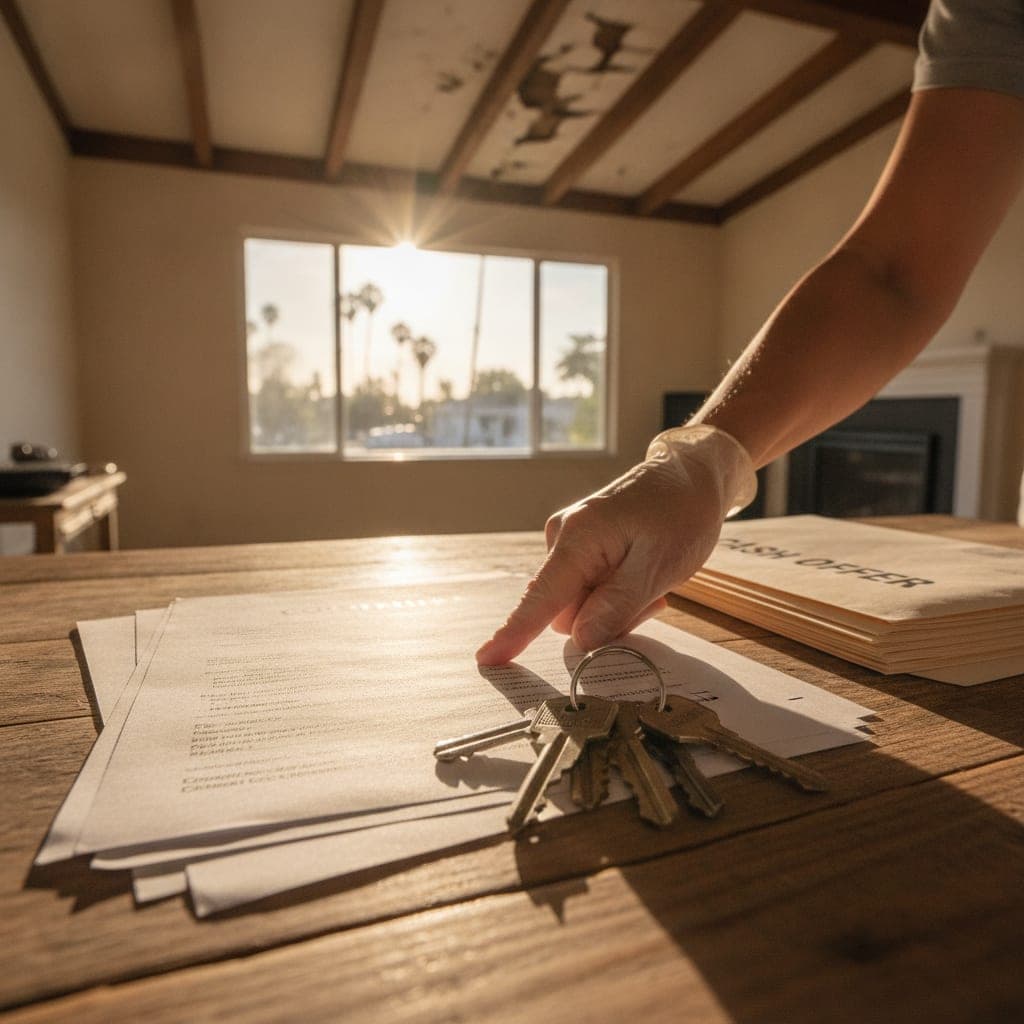
The short answer: most water-damaged California homes sell at 60 to 80 percent of their pre-damage after-repair value when the seller goes the cash-buyer route, and that is usually the only realistic path. Mold is the single biggest discount driver, remediation runs $5,000 to $30,000, and until it is finished a financed buyer cannot get loan approval because the property fails lender habitability standards. If you need to sell water damaged house fast, cash is not just the easiest option. It is often the only one.
This guide covers the four categories of water damage California buyers price differently, the insurance gotcha that catches most homeowners, the Civil Code §1102 disclosure trap, and a worked Riverside example showing the actual dollars on the table.
The four categories of water damage
Not all water is the same. The IICRC (the body that certifies water-damage restoration contractors) splits water intrusion into three categories, and California cash buyers add a fourth based on how the damage shows up at inspection.
Category 1, clean water. Burst supply line, pinhole leak in a copper pipe, overflowing bathtub. The water itself is not contaminated. If caught within 24 to 48 hours, drying and minor drywall replacement keeps the discount small, usually 5 to 10 percent off ARV.
Category 2, gray water. Dishwasher leak, washing-machine supply line, toilet overflow with no solids. Some contamination but not biohazardous. Drywall, subfloor, and cabinetry typically need replacement. Discount is steeper: 10 to 20 percent off ARV.
Category 3, black water. Sewage backup, river flooding, sustained groundwater intrusion. Everything porous in the contact zone has to come out, drywall to four feet above the line, subfloor, insulation, lower cabinets. Discount runs 20 to 40 percent off ARV depending on square footage affected.
Category 4, historical or hidden. Slow leak behind a wall for two years. Mold colony in an attic from a roof leak nobody noticed. This is the category that scares buyers most, because the visible damage is small and the hidden damage is large. Once a moisture meter or thermal camera finds it, financed buyers walk and the property moves to the cash market.
If you want to sell water damaged house at any of these severity levels, the buyer pool narrows the deeper you go into Category 3 and 4 territory.
Why financed buyers walk
A conventional, FHA, or VA lender will not fund a loan on a property with active leaks, untreated mold, or compromised structural integrity. The appraiser flags it. The underwriter requires repairs to be completed before close. The buyer either has to come up with cash for the repairs, find a renovation loan (FHA 203k, Fannie Mae HomeStyle), or walk.
Most walk. The 203k process takes 45 to 60 days, requires a HUD consultant, and kills momentum. By the time the financed buyer figures out what they are dealing with, you have lost 30 days of market time and the listing has gone stale.
This is why most water-damaged California homes route to cash buyers. A cash buyer does not need lender approval, they own the capital and they own the renovation. The path is faster, and on a property with active mold or unrepaired flood damage, it is essentially the only path. We cover the broader "can't qualify for a loan" pattern in we buy houses as-is, water damage is one of the most common reasons properties end up there.
The insurance gotcha most owners miss
Most California homeowner policies (HO-3, HO-5) cover sudden and accidental water damage, a burst pipe, a water heater that fails overnight, an appliance supply line that ruptures. They do not cover gradual water damage. A slow leak under the sink that ran for six months and rotted out the cabinet base is excluded under nearly every standard policy.
Flood damage is a separate category entirely. Standard homeowner policies exclude flood. You need a NFIP (FEMA) flood policy or a private flood policy, and most California homeowners outside FEMA-designated flood zones do not carry one. So if your house took on water from a storm event or a creek backup, your insurance is almost certainly not paying.
The practical implication: if the damage is gradual or flood-related, the homeowner is paying out of pocket. That repair bill, often $20,000 to $80,000 in a 1,500-square-foot California home, is the gap between selling at full ARV and selling as-is for cash. The cash discount and the out-of-pocket repair cost are usually within a few thousand dollars of each other, which is why so many owners just take the cash offer.
California disclosure law on water and mold
California Civil Code §1102 requires sellers to deliver a Transfer Disclosure Statement (TDS) covering all known material defects. Water intrusion history, mold history, and any past or present moisture issues are explicitly material. So is the §1103 Natural Hazard Disclosure (NHD) for properties in flood hazard zones.
Failure to disclose is not a slap on the wrist. The buyer has rescission rights, can sue for damages, and California courts have repeatedly sided with buyers in cases where sellers concealed mold or repeated water events. We cover the full disclosure framework in seller disclosures California: TDS and NHD.
The practical takeaway: you cannot paper over water damage. If you patch the drywall and list at full price, the buyer's inspector will find the moisture history (drywall replacement patterns are obvious to a trained eye, and a thermal camera reads the studs behind the patch). Once it is found, the deal either dies or renegotiates down, and you have created a documented disclosure problem that follows the property. Selling to a cash buyer with no inspection is legal, but skipping the inspection does not skip disclosure.
A cash sale to a buyer who explicitly takes the property as-is, with full written disclosure of the water history, eliminates that risk. The price reflects the damage, the buyer waives further claims, and the file closes clean.
Mold testing and remediation costs
If the damage produced visible or suspected mold, the cost stack looks like this:
- Air-quality test. $300 to $600 for a single-room test, $600 to $900 for whole-house with multiple sample sites. A licensed industrial hygienist runs it.
- Containment and removal. $10 to $25 per square foot of affected area. A 60-square-foot bathroom mold colony runs $1,500 to $2,000 just for the removal. A 400-square-foot kitchen-and-living-room flood with mold growth runs $8,000 to $15,000.
- Drywall, flooring, and reframing. $20 to $60 per square foot for affected areas, depending on finishes.
- Post-remediation clearance test. $400 to $700 for the second air-quality test that confirms the mold is gone.
Full remediation on a moderate Category 3 event in a California home runs $5,000 to $30,000 depending on square footage. The lower end is a small bathroom or laundry room. The upper end is a flooded first floor with structural drying and reframing. Add the four to six weeks of additional living expenses (ALE), averaging $4,000 to $9,000 in California for a hotel or short-term rental, and the total cost-to-cure regularly exceeds $25,000.
This is the math that drives sellers to the cash market. Spending $25,000 and six weeks to recover $40,000 in sale price is a thin margin once you factor in your time, the risk of finding more damage during remediation, and the holding costs.
Worked example: a $625k Riverside flood
A 1,650-square-foot single-story in Riverside takes on water from a kitchen supply-line failure at 2am on a Saturday. Water runs for six hours before the homeowner wakes up. Damage spreads to the kitchen, dining room, and adjacent hallway. By Monday, a 60-square-foot mold colony is visible behind the lower cabinet bank.
Pre-damage ARV: $625,000. The owner has two paths.
Path A, repair and list.
- Mold remediation, kitchen reframing, cabinet replacement, flooring, and paint: $18,000
- Four weeks of ALE (hotel + meals): $4,800
- Two months of additional mortgage and utility carry: $5,200
- Agent commission at 5 percent on $625,000: $31,250
- Closing costs: $4,500
- Net to seller after sale at $625,000: roughly $561,250
That assumes the work goes smoothly, no further damage is found behind the walls during demolition, and the property sells at full ARV with no buyer concessions. In practice, post-remediation listings often net 2 to 4 percent below comp value because the disclosure file shows the water event.
Path B, cash sale as-is.
- Cash offer at 82 percent of ARV: $512,500
- No repairs, no ALE, no commission, no closing costs paid by seller
- Net to seller: $512,500
- Time to close: 14 days
The gap is roughly $48,750, but it cost the seller eight to ten weeks of their life, $25,000 of out-of-pocket spending they had to front, and the risk that the project goes sideways. For most Riverside owners in this situation, the cash path wins on a risk-adjusted basis. We break the same math down on a broader scale in how much do you lose selling house as-is.
The same dynamic plays out across Riverside and inland markets where flood and irrigation-line failures are more common, and across San Bernardino, Corona, and Hemet where older housing stock means more original galvanized supply lines reaching end of life.
How a cash buyer prices a water damaged house
A real California cash buyer prices a water-damaged property using the same formula as any other distressed asset: ARV minus repair scope minus carry minus margin equals offer.
For water damage specifically, the repair scope estimate covers:
- Demolition and removal of affected materials
- Structural drying (3 to 7 days with industrial dehumidifiers)
- Mold remediation if any colony is present or suspected
- Reframing and subfloor replacement where needed
- Drywall, paint, flooring, and trim
- Cabinet and fixture replacement in the affected zone
- Post-remediation clearance test
- Buffer for hidden damage discovered during demolition
The "buffer for hidden damage" is the line that explains why cash offers on water-damaged homes look conservative. Water travels along studs, joists, and subfloors in ways that are not visible until demolition starts. A buyer who has done 50 of these jobs knows the actual scope is usually 20 to 40 percent larger than what the visible damage suggests, and they price the buffer in.
A buyer who does not price the buffer in either has not done many of these projects, or is planning to renegotiate during inspection once the buffer reveals itself. We cover that pattern in cash home buyer red flags.
The 14-day cash sale process
For a water-damaged property the cash-buyer timeline runs like this:
Day 1. Seller submits property details: address, photos of the damage if available, rough description of the event.
Day 2-3. Drive-by inspection from the outside. A buyer who is serious will also schedule a contractor walk-through within 48 hours. The contractor brings a moisture meter and, if mold is suspected, a thermal camera.
Day 4-5. Written offer with the math attached: assumed ARV, repair scope, and offer price. A reputable buyer will share the comps and the repair line items if you ask.
Day 6-7. Acceptance, contract, earnest money deposit. Use a neutral third-party escrow company.
Day 8-12. Title search and clearance. If there are no title issues, this is straightforward. If there are old liens or title defects, see /blog/sell-your-southern-california-home-for-cash-even-with-title-issues.
Day 13-14. Sign-and-close. Funds wire to your account. Possession transfer per the contract terms.
A water-damaged property does not require any extra steps beyond a standard cash sale. The damage is priced in. The disclosure is documented. The buyer assumes the renovation risk. We cover the full process in how to sell my house fast in California.
The same process applies whether you are selling in Los Angeles, San Diego, Long Beach, Orange County, Pasadena, Oceanside, or Carlsbad. The damage drives the discount; the location drives the comps.
If the water damage stacks with code-violation history (unpermitted plumbing, unpermitted bath additions, etc.), the property routes to /blog/sell-code-violation-property-in-california, same cash path, additional disclosure considerations. For homes where the damage is severe enough that the property is essentially uninhabitable, /blog/we-buy-southern-california-homes-in-any-condition covers the full as-is cash framework.
A clean offer on a damaged house
If you need to sell water damaged house in California, whether the event was last week or the damage has been hiding behind drywall for two years, get your offer. We close in 14 days, take the property as-is, and price the damage transparently with the math attached. No financing contingency, no inspection renegotiation, no required repairs. Just a written number, a signed contract, and a date on the calendar.
Common questions
Questions people ask about this
- Do I have to disclose water damage if it was repaired and there is no current issue?
- Yes. California Civil Code §1102 requires disclosure of past water intrusion and any known mold history, even if remediated. Failure to disclose can trigger rescission and damages. Document the repair receipts and the clearance test if you have them, that documentation actually strengthens the buyer's confidence rather than weakening it.
- Can I sell a house with active mold to a cash buyer?
- Yes. Cash buyers regularly purchase properties with untreated mold. They factor remediation into the offer and handle the work themselves after close. You do not need to remediate before selling.
- Will my homeowner's insurance pay for the damage?
- Depends on the cause. Sudden events (burst pipes, appliance failures) are usually covered. Gradual leaks, flood from storm or groundwater, and mold from prolonged moisture are usually not covered under a standard HO-3 policy. Read your policy or call your agent before assuming coverage.
- How much does a cash buyer pay for a water-damaged house in California?
- Typically 60 to 80 percent of pre-damage ARV depending on severity. Category 1 events with quick response: closer to 80 to 85 percent. Category 3 floods with mold and structural damage: 60 to 70 percent. The discount tracks the cost-to-cure plus a buffer for hidden damage.
- Can I sell a flood-damaged house in California without doing any repairs?
- Yes. A cash buyer will purchase the property in its current condition, with the damage fully disclosed in the contract. You do not need to dry it, demo it, or remediate it. The buyer handles all of that post-close.
Written by
Adrian HernandezCEO/Owner, My Home Sold
Adrian Hernandez founded My Home Sold in 2015 and has led it through more than 900 direct home purchases across Southern California. He has appeared on FOX 11 Good Day LA discussing the shift in the Southern California market and what it means for homeowners whose listings are not moving.
More about AdrianReady to Get Started?
Contact us today to learn how we can help you.