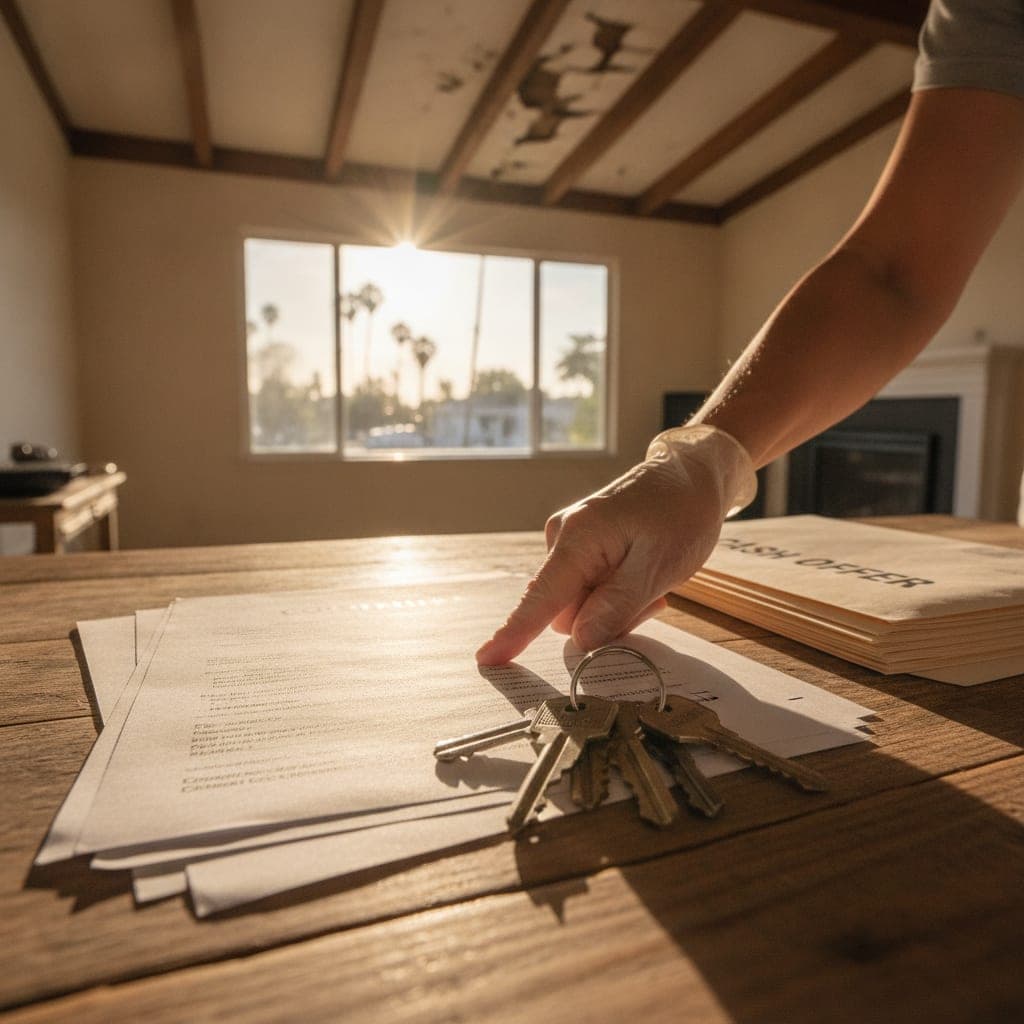

The fastest way to misread a cash offer is to compare it to your Zillow estimate. The cash offer vs market value gap most California sellers see, anywhere from 10 to 30 percent, is real, but the comparison itself is wrong twice over. A cash buyer is not pricing against today's listed market value. They are pricing against after-repair value (ARV) minus their repair scope, holding cost, and margin. And the seller is not actually netting market value when they list, because commissions, concessions, repairs, and four to six months of carrying costs come out of that headline number before it hits the bank account. This guide walks through the actual math with a Riverside example, a net-proceeds comparison table, and a clear read on when each path wins.
The two numbers most sellers confuse
Market value is what a retail buyer with a 30-year mortgage would pay for your home in its current condition, after it has sat on the MLS for 30 to 60 days, after a buyer's agent has negotiated, and after you have agreed to whatever inspection items show up. That is the number on Zillow, plus or minus 5 to 10 percent.
A cash offer is a different math problem. The buyer is solving for: what can I pay today, close in two weeks, take the property as-is, fund the repairs, hold it for four to six months, sell it at retail, pay closing costs twice, and still earn enough margin to justify the capital risk? That equation almost always lands at 70 to 85 percent of after-repair value, not 70 to 85 percent of current market value.
In other words: when a seller asks "how much less is a cash offer than market value," the honest answer is "it depends on the repair scope and the spread between current condition and after-repair value." A turnkey home in Newport Beach has almost no spread, the cash discount might be 5 to 10 percent. A 1962 Riverside fixer with $40,000 of deferred maintenance has a 25 percent spread, and the cash offer reflects that.
Why the gap exists, line by line
Four costs separate a cash offer from after-repair value. Each is real and each is something a retail buyer never has to underwrite:
Repair scope. The cash buyer pays a contractor to bring the property to retail condition. Roof, HVAC, kitchen, baths, paint, flooring, landscaping. In California labor and permit costs run higher than national averages, a kitchen remodel that books at $35,000 in Texas books at $55,000 to $70,000 in San Diego or Orange County. Permitting under California's Title 24 energy rules adds further cost.
Holding cost. From the day they buy to the day they sell, the buyer is paying property taxes (≈1.1 percent annually under Prop 13's 1 percent cap plus local assessments), insurance, utilities, HOA dues if applicable, and capital cost on the money tied up in the property. On a $700,000 acquisition, holding cost runs $5,000 to $7,000 per month. Five months of hold equals $25,000 to $35,000.
Transaction costs on the back end. The cash buyer pays buyer-side and seller-side closing costs twice, once when they buy from you, once when they sell to the retail buyer. Title, escrow, and California's transfer tax under Revenue & Taxation Code §11911 (typically $1.10 per $1,000 of value at the county level, with city add-ons in places like Los Angeles, Riverside, and Oakland). Plus 5 to 6 percent in commissions on the back-end sale.
Profit margin. A buyer who is risking $200,000 to $300,000 of capital for five months on a single property needs 8 to 12 percent margin to make the model work across a portfolio that includes the deals that go wrong. Without margin there is no business, and without a business there is no buyer.
Sum those four and you arrive at the 15 to 30 percent gap between after-repair value and the cash offer. That is the structural reason the cash offer vs market value comparison shows the spread it does, and it is why every honest cash offer vs market value worksheet eventually returns to the same five numbers. The deeper version of this math is laid out in how much do investors pay for houses.
Worked example: a $700k Riverside home
Let's run actual numbers on a property we see often in the Inland Empire: a 1,650 sq ft three-bedroom in Riverside, built 1968, original kitchen, 22-year-old roof, HVAC limping, polybutylene plumbing, popcorn ceilings, deferred yard work.
- After-repair value (ARV): $700,000, based on three closed comps within half a mile in the last 90 days, all renovated.
- Current condition market value: roughly $620,000, a retail buyer would pay this if they were willing to live with the kitchen and budget a remodel later. The number assumes a clean inspection, no surprises.
- Repair scope to reach ARV: $58,000 (kitchen $22k, both baths $14k, roof $12k, HVAC $7k, paint and floors $3k).
- Holding cost: $30,000 over 5 months.
- Back-end transaction costs: $42,000 (commissions $40k, transfer tax and escrow $2k).
- Target margin (10 percent of ARV): $70,000.
Cash offer math: $700,000 ARV − $58,000 repairs − $30,000 hold − $42,000 transaction − $70,000 margin = $500,000 cash offer.
That is roughly 71 percent of ARV and 81 percent of current condition market value. The seller's first reaction is usually "my house is worth $620k, not $500k." That reaction is the heart of the cash offer vs market value confusion. The $620k number is real, but it is not what the seller would net at the closing table, and the question that actually matters is the net-proceeds comparison, not the headline price.
The hidden cost of "market value" listing
Market value is a gross number. Net proceeds is what lands in the bank. The two are separated by a long list of costs that are not optional in a traditional California listing:
Commissions. 5 to 6 percent total, split between listing and buyer's agents. On $620,000 that is $31,000 to $37,200. Even after the 2024 NAR settlement reshaped how buyer-agent compensation gets disclosed, the seller still typically funds it directly or via concession.
Buyer concessions. In a balanced or buyer-leaning California market, sellers concede 1 to 3 percent for closing-cost help, repair credits, or rate buydowns. Add $6,000 to $19,000.
Repairs from inspection negotiation. The buyer's inspector finds the same issues a cash buyer would price into the offer up front. A retail seller responds with credits or repairs. On a 1968 Riverside home, $8,000 to $25,000 of inspection-driven cost is typical.
Pre-listing prep. Paint, deep clean, landscaping, minor repairs, staging. $4,000 to $12,000.
Holding cost during listing. Average California days-on-market in 2025 has run 35 to 70 days depending on submarket, then 30 to 45 days in escrow. Call it four months. Mortgage interest, taxes, insurance, utilities, $3,500 to $5,000 per month for a typical Inland Empire property. Add $14,000 to $20,000.
Disclosure-driven costs. California's Civil Code §1102 disclosure regime is among the most expansive in the country. The Transfer Disclosure Statement, Natural Hazard Disclosure Report, and the Seller Property Questionnaire all surface conditions that frequently lead to repair requests or price reductions. Budget $1,500 for the disclosure package and $5,000 to $15,000 for whatever it surfaces.
Stack them up: a $620,000 listed sale typically nets $510,000 to $545,000 to the seller after four months. That is the apples-to-apples number to compare against a $500,000 cash offer that closes in two weeks.
Net-proceeds comparison table
Same Riverside property, two paths:
| Line item | Cash sale (close in 14 days) | Traditional listing (close in 4 months) |
|---|---|---|
| Sale price | $500,000 | $620,000 |
| Agent commissions | $0 | −$34,100 (5.5%) |
| Buyer concessions | $0 | −$12,400 (2%) |
| Inspection-driven repairs/credits | $0 | −$15,000 |
| Pre-listing prep and staging | $0 | −$8,000 |
| Seller closing costs (escrow, title, transfer tax) | −$1,500 (buyer pays most) | −$5,200 |
| Holding cost during sale | −$2,800 (2 weeks) | −$18,000 (4 months) |
| Disclosure package and reports | $0 (buyer accepts as-is) | −$1,500 |
| Net to seller | $495,700 | $525,800 |
The spread is $30,100, about 4.8 percent of the headline market value, not the 17 percent the seller assumed when they first compared $500k to $620k. And that spread assumes the listing goes well: clean inspection, no rate-driven price drops, no two-month re-list after a buyer falls out of escrow. When any of those go sideways, the listing path can net less than the cash offer.
This is the calculation we walk every seller through on the sell my house for cash page. The spread shrinks fast once you net out the costs nobody mentions in the listing pitch. We see the same dynamic when comparing offers on vs Opendoor, different model, same underlying math.
When the cash discount is worth it
The net-proceeds spread above is the headline number. But for a lot of California sellers, the real math includes time, certainty, and the ability to skip a four-month renovation-and-listing cycle. Where the cash offer wins:
Foreclosure timeline. Once the Notice of Default is recorded, you have roughly 90 days before the Notice of Trustee Sale, then 21 more days before auction. A four-month listing does not fit that window. A two-week cash close does. We cover the timeline on foreclosure situations, a $30,000 net-proceeds gap is irrelevant if the alternative is losing the entire equity at auction.
Inherited property. California's probate process can take 9 to 18 months without independent administration authority. If multiple heirs need to be paid out and the property has deferred maintenance, a cash sale closes the estate cleanly. We see this constantly with inherited house situations, coordinating four siblings to fund $60,000 of repairs before listing is usually impossible.
Property condition. Code violations, fire damage, hoarder cleanout, foundation work, failing septic. A retail buyer's mortgage lender will not fund a property with material habitability issues. The seller's options collapse to cash. The we buy houses as-is path exists precisely because the financed-buyer pool is closed for these properties.
Out-of-state owner. Coordinating a four-month listing from Phoenix or Boston, disclosures, repairs, contractor bids, showings, costs more in time and travel than the net-proceeds gap.
Divorce or job relocation. When the timeline is fixed by a court order or a new-job start date, certainty has a price. A two-week cash close eliminates the risk of a buyer falling out of escrow at week six.
When listing on the market wins
The cash offer vs market value gap is not always worth taking. The cash discount makes less sense when:
The home is turnkey. Updated kitchen, newer roof and HVAC, no deferred maintenance. Cash buyers cannot underwrite a meaningful repair budget, so the spread between ARV and current condition collapses. Net proceeds favor listing by 8 to 15 percent.
The neighborhood is hot. West LA, Newport Beach, parts of Pasadena, coastal San Diego. Days on market under 14, multiple offers above asking. The traditional listing premium overwhelms the cost stack. We see this dynamic on every offer in Newport Beach and Pasadena.
You have time and bandwidth. If you can absorb four months of carrying cost, coordinate inspections and repairs, and ride out a 30-day re-list if the first buyer falls out, listing is the higher-net path on a clean property.
You can live in it during the listing. Holding cost shrinks dramatically when the seller is not paying a mortgage on a vacant property. A $2,500 monthly hold on a primary residence is mostly principal and interest you would be paying anyway.
The honest framing is that the cash offer vs market value math is a decision about your specific property and your specific situation, not a generic verdict. We lay out both paths in how to sell my house fast in California, sometimes the answer is "list it."
How to read a cash offer vs market value worksheet
A legitimate cash offer should show its work. When a buyer hands you a number, ask for the worksheet and look for these five lines:
- After-repair value (ARV). What the buyer believes the property will sell for after renovation. Should reference three specific closed comps, with addresses and dates. If they cannot show comps, the offer is not underwritten.
- Repair scope. A line-item budget, kitchen, bath, roof, HVAC, mechanicals, cosmetics. A real number, not a round $50,000 placeholder. Compare it against your own contractor's read on the property.
- Holding period and cost. Months from close to resale, multiplied by monthly carrying cost. Should reference your specific submarket's days-on-market.
- Transaction costs. Buy-side and sell-side closing costs, including California's transfer tax, escrow, title, and back-end commissions.
- Margin. What the buyer is keeping. A buyer who refuses to disclose this is hiding something. Reasonable margins are 8 to 12 percent of ARV; anything above 15 percent is overpricing the deal in their favor.
A buyer who can produce all five lines is operating a real business. A buyer who cannot is either inexperienced or planning to renegotiate later. We unpack the renegotiation playbook in detail in the we buy houses ripoff explained, knowing what a clean offer looks like is the best defense.
Get the worksheet, then decide
The cash offer vs market value question deserves a worksheet, not a slogan. If you want to see what a clean, fully shown-work offer looks like on your specific property, ARV with comps, repair scope by line item, holding cost, transaction costs, and margin, get your offer. 24-hour turnaround, no obligation, and you can walk it through against any competing bid or your agent's listing pitch. The math should make sense before you sign anything. See how we price cash for homes in California.
Common questions
Questions people ask about this
- What percentage of market value is a typical cash offer in California?
- A cash offer typically lands at 70 to 85 percent of after-repair value, which translates to roughly 80 to 92 percent of current condition market value depending on the repair scope. A turnkey home gets a smaller discount; a heavy fixer gets a larger one. The cash offer vs market value spread is driven by repair scope, not by the buyer being aggressive.
- Is a cash offer always lower than a listed sale price?
- The headline number is almost always lower. The net proceeds, what actually lands in your bank, are often within 5 to 10 percent, and on properties with significant deferred maintenance, the cash net can match or beat the listing net once commissions, concessions, repairs, and four months of carrying costs come out.
- Do I have to pay closing costs on a cash sale in California?
- Most reputable California cash buyers cover the bulk of escrow and title fees. The seller typically still pays the county transfer tax under Revenue & Taxation Code §11911 (about $1.10 per $1,000 of sale price) and any city-level transfer tax, plus payoff fees on existing loans. There are no commissions and no buyer concessions.
- Can I get more than one cash offer to compare?
- You should. Three cash offers from three independent buyers will tell you whether your first number is reasonable. The best cash home buyers in California will not pressure you to sign immediately and will give you a worksheet you can compare against competing offers. If a buyer demands a same-day decision, that is a signal, not an emergency.
- Does the cash offer change after inspection?
- A cash offer should not change after inspection, with a reputable buyer. The whole point of the cash model is that the buyer takes the property as-is and prices the repair scope into the original number. Mid-escrow renegotiations are the move that gives the industry a bad reputation. We cover the legitimacy question on are cash home buyers legit.
- How does this math change for an inherited or out-of-state property?
- The per-line-item costs are the same, but the time-and-coordination cost of a traditional listing rises sharply. We have a dedicated walkthrough in selling an inherited house in California, for most heirs, the cash path nets more after probate timelines and out-of-state coordination costs are factored in.
Written by
Adrian HernandezCEO/Owner, My Home Sold
Adrian Hernandez founded My Home Sold in 2015 and has led it through more than 900 direct home purchases across Southern California. He has appeared on FOX 11 Good Day LA discussing the shift in the Southern California market and what it means for homeowners whose listings are not moving.
More about AdrianReady to Get Started?
Contact us today to learn how we can help you.