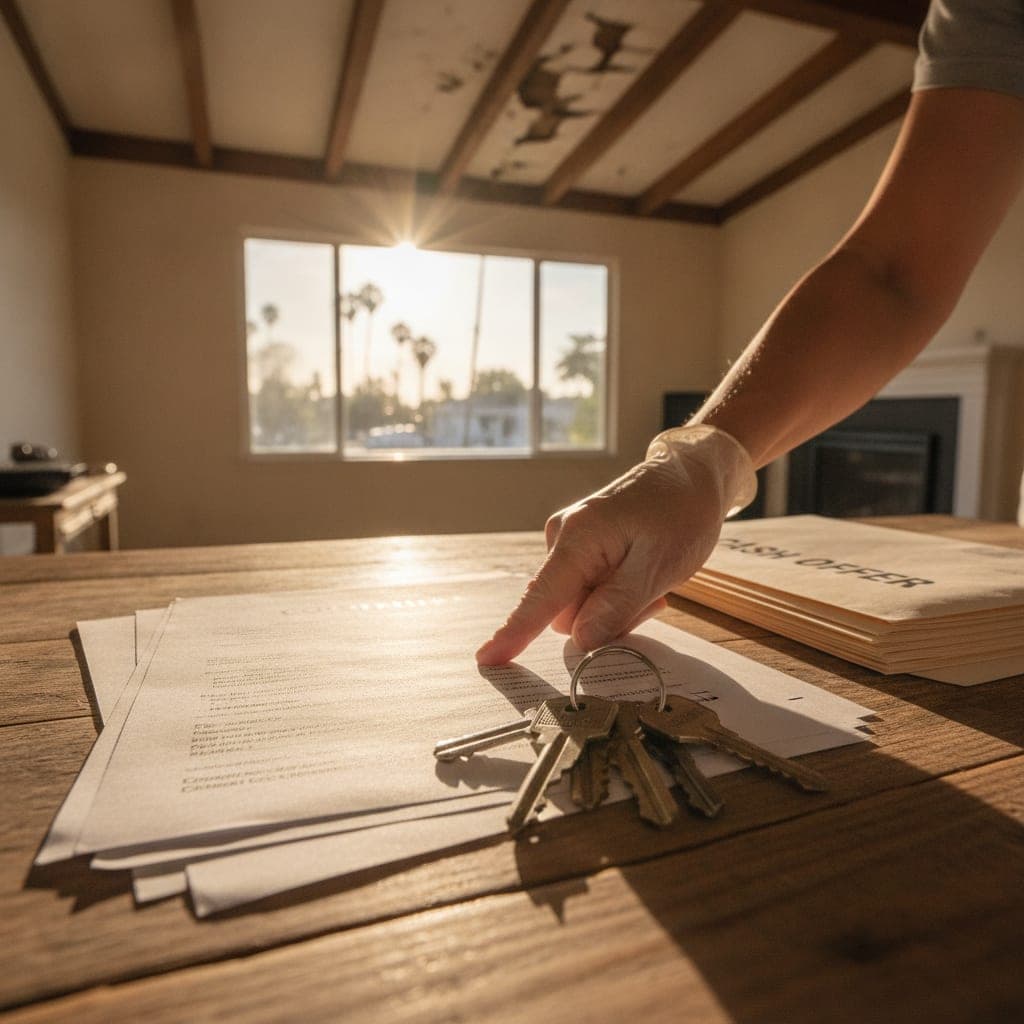
If you have inherited a house in California, you are looking at three things at once: a legal process (probate or trust administration), a tax picture (stepped-up basis, Prop 19, capital gains), and a property that may need work, may have a tenant, or may sit empty while bills accumulate. This guide walks through how selling an inherited house actually works in California, the timeline, the paperwork, the tax math, and the choice between listing retail and selling for cash.
The 60-second overview
In California, selling an inherited house typically follows this sequence:
- Determine whether the property is in a trust (faster) or going through probate (slower).
- If probate, file the petition and obtain Letters Testamentary or Letters of Administration.
- Get the property appraised as of the date of death (this sets your tax basis).
- Decide between listing retail, selling for cash, or holding as a rental.
- Sell. Pay off the mortgage and any liens at close. Distribute proceeds per the will or trust.
The whole process takes 2 to 4 months in a trust, 6 to 12 months in probate, sometimes longer. The financial outcome depends heavily on how you handle the tax-basis step and the sale-method decision. Both are covered below.
Probate vs. trust: which path are you on?
The single biggest factor in your timeline is whether the deceased held title in a revocable living trust or simply in their own name.
If the property is in a trust, the successor trustee has authority to sell almost immediately. There is no court involvement. A title company will need a copy of the trust certification, a death certificate, and the successor trustee's identification. You can typically list or accept an offer within 30 days of the death.
If the property is held in the deceased's name alone, it usually has to go through California probate. The personal representative (named in the will, or appointed by the court if there is no will) needs Letters Testamentary or Letters of Administration before they can sign a deed. That document takes 2 to 6 months to obtain depending on county backlog.
A few exceptions allow you to skip full probate:
- Spousal Property Petition if the surviving spouse is the sole beneficiary.
- Affidavit of Real Property of Small Value if the property is worth $61,500 or less (rare in California).
- Heggstad Petition if there is clear written intent to put the property into the trust but the deed transfer was never completed.
If you are not sure which path you are on, the deed and any trust documents will tell you. A probate attorney can confirm in a 30-minute consult.
The probate timeline in California
California probate is a public, court-supervised process with a fairly predictable timeline. From the perspective of selling the inherited property:
| Phase | Typical duration |
|---|---|
| File petition + serve notice | 4–8 weeks |
| Hearing + Letters issued | 6–12 weeks |
| Inventory + appraisal | 4–8 weeks (overlapping) |
| Notice to creditors (4-month statutory period) | 16 weeks |
| Sale (with court confirmation if required) | 6–10 weeks |
| Final accounting + distribution | 6–12 weeks |
The practical floor is around 7 to 9 months. The realistic average for an uncomplicated estate is 9 to 14 months. Contested estates or those with complex tax issues can run 18 to 36 months.
Properties can be sold during probate, before final distribution, with court approval. There are two procedures:
- Independent Administration of Estates Act (IAEA) full authority: the personal representative can sell with a 15-day notice to heirs, no court hearing required. This is the typical path.
- Court-supervised sale: required if the will restricts authority, if heirs object, or if the personal representative does not have IAEA authority. Slower (adds 4 to 8 weeks) and includes overbid procedures at the confirmation hearing.
We cover the full process on the inheritance situation page.
The tax picture in plain English
The good news for almost every California heir: the tax picture is friendlier than you probably think. Three rules drive the numbers.
Stepped-up basis and why it matters
When someone dies, the cost basis of their assets resets to the fair market value as of the date of death. This is the stepped-up basis rule.
Example: your father bought the house in 1986 for $185,000. He died in May 2026 when the house was worth $1,150,000. Your basis as the heir is $1,150,000, not $185,000. If you sell shortly after death for $1,150,000, your taxable gain is roughly zero.
This is the single most important tax fact about selling an inherited house. It usually wipes out 80 to 100 percent of the capital gains liability that would have applied if your parent had sold the house themselves.
To lock in the step-up you need a date-of-death appraisal. Get one from a licensed California appraiser (typically $400 to $700) within 6 months of the death. Do not rely on the county tax assessor's value or a Zestimate, neither stands up to IRS scrutiny.
Proposition 19 and the property-tax reset
California's Proposition 19, effective February 2021, changed how property taxes transfer when a parent dies and a child inherits.
Under the old rule (Prop 58), a child inheriting a primary residence from a parent could keep the parent's property-tax basis indefinitely, regardless of whether they lived there. Under Prop 19, the child can only keep the parent's property-tax basis if:
- The child uses the property as their primary residence within one year of inheriting, AND
- The fair market value at transfer is no more than $1,000,000 above the parent's assessed value.
If the child does not move in, or if the value gap exceeds $1,000,000, the property is reassessed at fair market value. This typically increases the annual property tax bill by $5,000 to $20,000+ in coastal California markets.
For most heirs who do not plan to live in the property, this means the property-tax bill is going to spike at reassessment. That increased carrying cost is one reason many inherited-property heirs sell rather than hold.
Capital gains on the sale
If you sell the property within a year of the death, your gain is usually small (the sale price minus the date-of-death appraisal value, minus selling costs). At zero or small gain, capital-gains tax is minimal.
If you hold the property and sell years later, gains are calculated against the stepped-up basis, not the original purchase price. Long-term capital gains rates apply (0%, 15%, or 20% federal, plus California's marginal income tax rate of up to 13.3%).
Selling costs that reduce your taxable gain include agent commissions, escrow fees, title insurance, transfer taxes, and any capital improvements you made between inheritance and sale. Routine repairs do not reduce gain. Permitted improvements (new roof, kitchen remodel, ADU build) do.
This is general information, not tax advice. A California CPA who specializes in real estate can save heirs five-figure sums on a typical inherited-property sale. Worth the consult.
Decision tree: list, rent, or sell for cash?
Once you have authority to sell (trust certification or Letters), the question is which exit. Three options, with rough rules of thumb:
List with an agent if:
- The property is cosmetically presentable
- You have 90 to 120 days of patience
- Co-heirs are aligned on the path
- You can fund $15,000 to $40,000 of pre-list prep without strain
- The property is in a hot market (under 30 days on market typical)
Hold as a rental if:
- The property cash-flows after the post-Prop 19 tax reassessment
- Co-heirs are aligned on holding rather than selling
- You are willing to be a long-distance landlord (or hire a property manager)
- The neighborhood is appreciating faster than typical investment alternatives
Sell for cash if:
- The property needs significant repairs
- Co-heirs cannot agree on prep decisions
- You live out of state and cannot manage the listing process
- The probate timeline is stretching the family financially
- A tenant in place will not cooperate with showings
- You simply want it done
Most heirs in San Diego, Los Angeles, or Orange County end up running the same calculation: how much will the prep cost, how long will the listing take, and how much will I net after commissions and carrying costs versus a cash offer that closes in 14 days. The answer varies by property, but for inherited properties the cash math is more competitive than people expect.
Selling during active probate
Most inherited-property sales in California close before probate is fully complete, using the IAEA full-authority path. The mechanics:
- The personal representative obtains Letters with full authority.
- The property is listed or marketed for cash offers.
- An offer is accepted, contingent on probate authority confirmation.
- The personal representative sends a Notice of Proposed Action (NOPA) to all heirs at least 15 days before close.
- If no heir objects within 15 days, the sale closes normally.
- If an heir objects, the sale must go to a court hearing with overbid procedures.
For a cash sale this typically adds about 21 to 30 days to a transaction that would otherwise close in 14. Worth it for most heirs because it avoids 6+ months of carrying costs and puts the proceeds into the estate for distribution.
Multiple heirs: the practical playbook
The single most common inherited-property dispute is between heirs who want different things, one wants to sell, one wants to keep it, one wants to rent it, one needs the cash now. A few patterns help:
- Get the date-of-death appraisal first. A neutral number turns down the temperature of every subsequent decision.
- Agree on the decision-making process before debating the decision. Majority rule? Unanimous? Personal-representative call with consultation? Pick the rule first.
- One heir can buy the others out. Often the cleanest outcome. The buying heir gets a mortgage or pays cash, refinances at fair market value, and takes title. Other heirs get cash equal to their share.
- A cash sale is often the lowest-conflict exit. It is fast, it is final, and it produces a single number to divide. Listing and renting both extend the period of disagreement.
- A partition action is the last resort. California allows any co-owner to force a sale through court. It works, but it costs $15,000 to $50,000 in legal fees and 6 to 18 months. Avoidable in almost all cases.
If a foreclosure or code-violation issue is in play on top of the inheritance, the cash exit becomes more attractive because the timeline is no longer optional.
Cleaning out a parent's house
Before you can sell, retail or cash, the property usually needs to be cleared of decades of belongings. A few practical notes:
- Do not throw anything away in the first 30 days. Heirs frequently regret early decisions. Sort, label, and store.
- Estate sales recover 10 to 30 percent of replacement cost for furniture and belongings. For high-value collections (jewelry, art, coins), use a specialist auction house instead.
- Donate rather than dump where possible. Habitat for Humanity ReStore picks up large items free in most California counties.
- Hoarding situations need professional remediation. Specialty cleanout companies in California charge $5,000 to $25,000 depending on scope. Cash buyers will buy hoarder houses without requiring cleanout, a meaningful option if the situation is overwhelming.
- Document everything before disposal. Photos serve as evidence for tax basis and for any future heir disputes about sentimental items.
If the cleanout itself is the blocker, selling the property in any condition is sometimes the cleanest path forward.
Want a written cash number for an inherited property?
If you want to see what a written cash offer would look like, before deciding whether to list or sell, get your offer. 24-hour turnaround, no fees, no obligation, and we work directly with personal representatives, trustees, and probate attorneys throughout California. Take the number, compare it to a retail-net estimate, and pick the path that fits your family.
Common questions
Questions people ask about this
- Do I have to wait for probate to close before selling?
- No. Most California probate sales close during probate using the IAEA full-authority path. The Notice of Proposed Action procedure adds about 15 days to the transaction.
- Will I owe capital-gains tax on an inherited house I sell quickly?
- Usually little or none, because of the stepped-up basis. Selling within a year of death typically results in a near-zero gain (sale price minus appraised value minus selling costs).
- Does a cash sale to an investor work in probate?
- Yes. A reputable California cash buyer is familiar with probate sales and the NOPA procedure. The transaction structure is the same as any other cash sale, written offer, proof of funds, escrow at a neutral title company.
- Can I sell if the will is being contested?
- Selling with a contested will is harder. A contested will usually freezes property sales until the contest is resolved. A trust is more flexible because the trustee retains authority. If contest is likely, talk to a probate litigator early.
- What if the inherited house has a reverse mortgage?
- The reverse mortgage becomes due within 6 months of the death. You can sell the property and pay off the loan from proceeds, or hand the property back to the lender (deed in lieu). Most heirs sell, because California real estate values typically exceed reverse-mortgage balances. The clock matters here, talk to the loan servicer immediately.
- Are cash buyers really the right fit for inherited properties?
- For properties needing work, properties with cooperative co-heirs who want it done, and properties owned by out-of-state heirs, yes. For move-in-ready properties with patient heirs in a hot market, a retail listing usually nets more. The right choice depends on the specific property and family situation. We compare the retail-vs-cash math here and you can vet whether the cash route is right by reading are cash home buyers legit.
Written by
Adrian HernandezCEO/Owner, My Home Sold
Adrian Hernandez founded My Home Sold in 2015 and has led it through more than 900 direct home purchases across Southern California. He has appeared on FOX 11 Good Day LA discussing the shift in the Southern California market and what it means for homeowners whose listings are not moving.
More about AdrianReady to Get Started?
Contact us today to learn how we can help you.