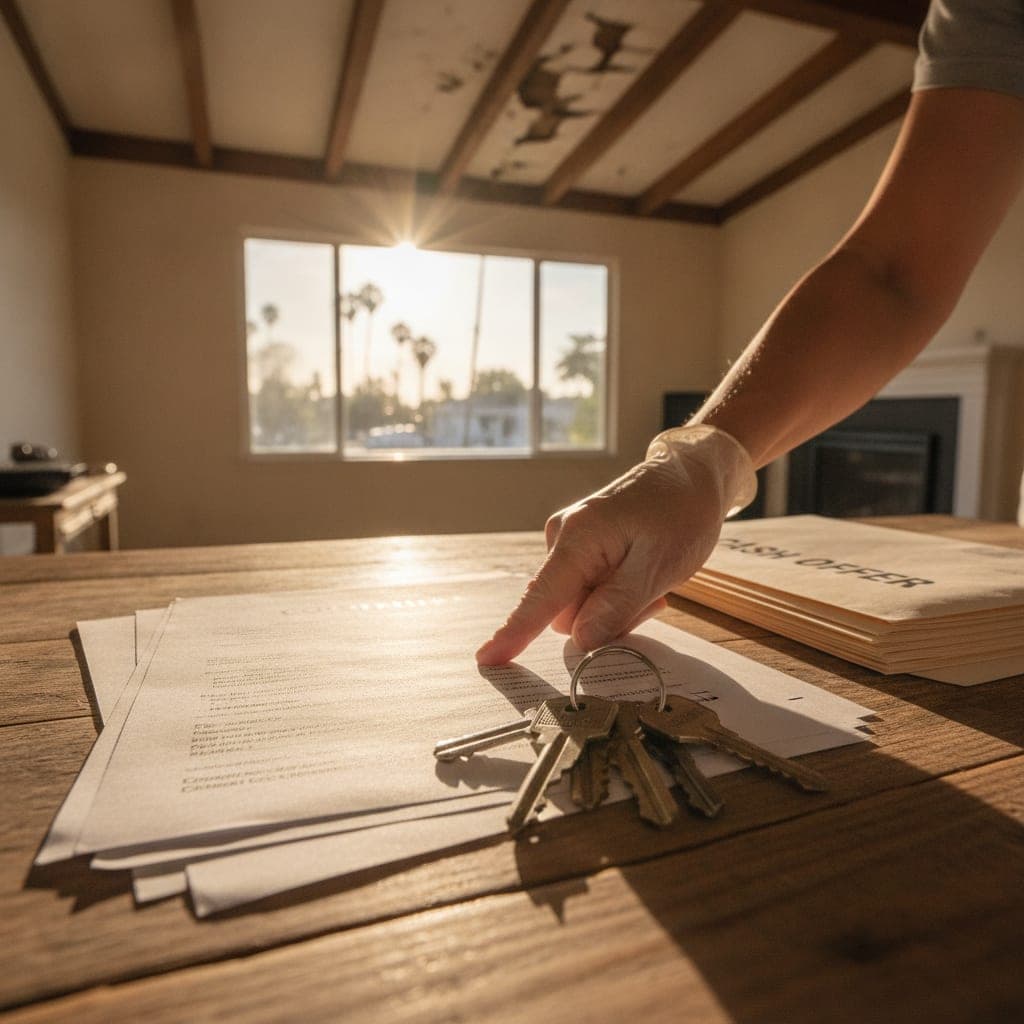

The short answer: homes with documented structural problems trade at 65 to 85 percent of their pre-issue after-repair value, depending on severity. To sell house foundation issues in California, you have three honest paths, repair before listing, disclose and discount on the open market, or sell as-is to a cash buyer who underwrites the repair themselves. Which one nets the most depends entirely on the engineer's report, the regional soil conditions, and how much liquidity you have to fund repairs that may take 60 to 120 days. This guide walks through severity tiers, California-specific risks, the disclosure rules that govern every sale, and the math that decides whether to fix or sell as-is.
The four severity tiers
Not every crack is a crisis. When you sell house foundation issues in California, the first job is figuring out which tier you are in, because the discount the market applies, and the buyer pool you can reach, changes dramatically at each step.
Tier 1, Hairline cosmetic cracks. Vertical hairline cracks under 1/16 inch in stucco, drywall, or slab edges. Almost every California home over 20 years old has them. Negligible market discount. A standard buyer with a conventional loan closes without issue. Disclose them on the TDS, attach photos, move on.
Tier 2, Monitored cracks. Cracks 1/16 to 1/4 inch, no measurable differential movement in the last 12 months, no doors sticking, no sloping floors. Engineer report says "stable, monitor annually." Market discount: 5 to 10 percent off comp value. Financed buyers can usually still close, though some lenders flag it for additional review.
Tier 3, Active settling or heaving. Cracks wider than 1/4 inch, doors and windows out of square, floors visibly sloped (use a marble), engineer documents ongoing movement. Repair scope typically $20,000 to $80,000. Most conventional and FHA lenders will not fund without the repair completed and re-inspected. Market discount on as-is: 15 to 25 percent. This is where most sellers either commit to the repair or pivot to a cash buyer. If you are in this tier, the we buy houses as-is path usually nets more than fighting through three failed financed escrows.
If your inspector or contractor has already used the words "differential settlement" or "active movement," you are in Tier 3 territory and the sell house foundation issues conversation needs to start with a cash buyer or a renovation lender, not a retail listing.
Tier 4, Major structural failure or hillside slip. Foundation pulled away from the home, hillside creep with documented displacement, post-earthquake red-tag, or unreinforced masonry that cannot be retrofit economically. Repair scope $80,000 to $300,000+, sometimes demo-and-rebuild only. Cash buyer or land-value buyer. Market discount on as-is: 25 to 40 percent off comparable repaired value. The any condition buyer pool exists specifically for Tier 4 properties.
California regional risks
When you sell house foundation issues, the regional context matters as much as the crack width. California's geology stacks the deck differently in every region. Knowing which risk applies to your property changes both the disclosure narrative and the buyer's discount math.
Expansive clay soil, Inland Empire, parts of San Diego County. Bentonite-heavy clays swell when wet and shrink when dry, cycling the slab up and down each season. Cities like Riverside, San Bernardino, Corona, Fontana, and Moreno Valley sit on some of the most reactive soils in the state. Expansive soil sell house cases typically present as horizontal cracks at slab edges, doors that stick in winter and free in summer, and tile cracks following grout lines. Repair often requires both pier underpinning and a perimeter drainage system to stabilize moisture content.
Hillside settlement, LA hills, OC canyons. Cut-and-fill construction on slopes settles unevenly for decades. Pasadena, the Hollywood Hills, parts of Los Angeles, and the Orange County canyons see chronic differential settlement. Symptoms: one corner of the home noticeably lower, retaining walls leaning, pool decks separating from coping. Repair: deep helical or steel push piers tied to bedrock. Cost scales with depth.
Seismic damage, post-Northridge homes, masonry. Older homes that lived through 1971 Sylmar, 1987 Whittier Narrows, 1994 Northridge, or 2019 Ridgecrest may have cumulative cracked-foundation home sale risk that only shows up when an engineer pulls baseboards. Unreinforced masonry (URM) and pre-1980 cripple walls are the highest-risk classes.
Liquefaction zones, port and bayfront areas. Long Beach, parts of San Diego near the bay, and Bay Area infill have liquefaction-susceptible soils. After a quake, saturated sandy soils temporarily lose bearing capacity. Even without a recent quake, lender appraisers will flag homes in mapped liquefaction zones and may require additional structural review.
Soft-story retrofit and LA Ordinance 183893
If you own a multifamily wood-frame building in Los Angeles built before 1978 with tuck-under parking or a weak ground-floor wall line, you are likely on the soft-story retrofit list under LA Ordinance 183893. The city has been working through compliance notices since 2015. Selling house with structural damage that is also under an open retrofit order is a different transaction from selling a single-family with a cracked slab.
Key points for sellers:
- The retrofit obligation runs with the property. The new owner inherits whatever timeline is on the city's notice.
- Retrofit costs typically run $5,000 to $25,000 per unit, sometimes higher for complex geometries.
- Buyers with conventional financing on a 5+ unit building will usually require the retrofit completed before close, or escrow funds to cover it.
- Soft story retrofit California obligations also exist in San Francisco, Berkeley, West Hollywood, Santa Monica, and several other jurisdictions. Each has its own compliance timeline.
For properties stuck in this category, the cleanest path is often a cash buyer who specializes in retrofit-required multifamily. The code violations buyer pool overlaps heavily with the retrofit-required pool.
The foundation engineer report
Before you list, repair, or call a cash buyer, get a baseline foundation engineer report. Cost: $400 to $900 for a single-family home, $1,200 to $2,500 for a multifamily or hillside. The report should include:
- Crack mapping with widths and orientations
- Floor-level survey (typically using a Ziplevel or laser) showing differential elevation across the slab
- Soil classification if relevant (expansive index for clay zones)
- Recommended scope of repair
- A clear opinion on whether the movement is active (currently progressing) or monitored (stable for 12+ months with no measurable change)
That "active vs monitored" line is the single most important sentence in the report. It determines which buyer pool can finance your home, what the cash discount looks like, and whether the disclosure conversation goes smoothly or turns into a rescission risk down the road.
Your disclosure obligation under Civil Code 1102
California Civil Code 1102 makes known foundation issues a material fact you must disclose on the Transfer Disclosure Statement (TDS). Failure to disclose is grounds for rescission, damages, and in serious cases punitive liability. There is no "as-is" workaround for known defects, selling as-is means the buyer takes the house with its known condition, not that you can hide what you know.
What counts as known:
- Anything in an engineer report you commissioned
- Anything a contractor told you in writing during a bid
- Anything you have personally observed (sloping floors, cracked tile patterns, doors that drift open)
- Prior insurance claims for foundation or earth-movement events
- Prior repair work, even if you believe it cured the issue
For a deeper walkthrough of the TDS and the related Natural Hazard Disclosure form, see our seller disclosures California TDS NHD guide. The short version: when you sell house foundation issues, more disclosure protects you, not less. Attach the engineer report. Attach the contractor bids. Have the buyer initial each page.
Why financed buyers struggle
When you list a home with active structural movement on the MLS, here is what typically happens:
- Three or four offers come in. One or two are cash. The rest are financed.
- The financed offers go into escrow. The lender orders an appraisal.
- The appraiser flags the foundation issue and requires a structural engineer's sign-off.
- Your engineer report comes back saying "active settlement, repair recommended."
- The lender denies the loan as collateral does not meet underwriting standards. Buyer cancels.
- You repeat the cycle with the next financed buyer.
This is why properties with Tier 3 or Tier 4 issues spend 90 to 180 days on the MLS before sellers either commit to the repair or pivot. The financed buyer is not the problem, the financed buyer's lender is. Until the engineer's letter says "stable, no further movement expected," the loan does not fund.
A cash buyer skips the entire chain. They underwrite the repair themselves and price it into the offer. The trade-off is the discount you take versus a cured-property MLS sale, typically 12 to 22 percent, in exchange for not fronting $40,000 of repair capital and not waiting four months.
Repair cost ranges
Real California numbers, current as of 2026:
- Pier or post replacement (raised foundation, typical bungalow): $8,000 to $20,000
- Helical or push piers (slab, perimeter underpinning, 8 to 12 piers): $15,000 to $35,000
- Partial slab repair (mudjacking or polyurethane lift, isolated section): $4,000 to $12,000
- Full slab replacement (tear-out, regrade, repour): $30,000 to $80,000
- Seismic retrofit (single-family cripple wall + bolt-down): $5,000 to $15,000
- Soft-story retrofit (per unit, multifamily): $8,000 to $25,000
- Hillside stabilization (drainage + retaining + piers): $40,000 to $150,000+
Add 10 to 15 percent for engineer fees, permits, and city plan check. Add another 10 percent for the cosmetic repair the foundation work disturbs (drywall, tile, paint, sometimes flooring). A homeowner who quotes a contractor at $42,000 should budget $52,000 to $58,000 all-in by the time the home shows like nothing happened.
Worked example: Pasadena hillside
A homeowner in Pasadena inherits a 1,950 sqft hillside home. Engineer report: 1.5 inches of differential settlement across the slab, active movement over the last 18 months, recommended repair is 9 steel push piers plus a perimeter drainage upgrade. Contractor bid: $42,000. Repaired ARV based on neighborhood comps: $1,020,000.
Path A, Repair, then list.
- Repair cost: $42,000 + $7,000 cosmetic + $3,000 engineer/permit = $52,000
- Time: 8 to 14 weeks for repair, then 30 to 45 days to list and close
- Sale price: $1,020,000
- Agent commission (5%): $51,000
- Other closing costs (1.5%): $15,300
- Carrying costs during repair (mortgage, insurance, utilities, ~$5,500/mo for 3 months): $16,500
- Net: $885,200
Path B, Disclose and list as-is on the MLS.
- Sale price after disclosure discount (15-20%): $830,000 to $870,000, call it $850,000
- Agent commission: $42,500
- Other closing costs: $12,750
- Carrying costs while waiting for the right buyer (estimated 4 months): $22,000
- Net: $772,750
- Risk: failed financed escrows extending the timeline further
Path C, Cash buyer, as-is, no repairs.
- Cash offer: $720,000 (around 71% of repaired ARV)
- No commission
- No closing costs paid by seller
- Carrying costs (3-week close): $4,000
- Net: $716,000
In this case Path A wins by $113,000 over Path C, but only if the homeowner has $52,000 in repair capital, can wait 4+ months, and has the appetite to manage a structural job. For a seller without that capital or that timeline (inherited estate, divorce, relocation, financial pressure), Path C is the rational choice. Run your own numbers; the answer is not universal. We unpack this comparison further in cash offer vs market value California.
How a cash buyer underwrites foundation issues
When you call us about a property in Los Angeles, San Diego, or anywhere across California to sell house foundation issues, the underwriting process looks like this:
- Initial walkthrough. We look at slab edges, door frames, tile patterns, ceiling cracks. We use a marble on the floor. We pull a baseboard if you let us.
- Our own engineer. We bring a licensed California structural engineer, on our cost. Their report tells us what we are buying.
- Repair scope and bid. We get our own contractor numbers, not your contractor's number. Our network typically prices 15 to 25 percent below retail because we run dozens of these jobs a year.
- Offer math. ARV after our repairs, minus repair scope, minus holding costs (typically 4-6 months), minus our margin (usually 10-15 percent of ARV). The result is the cash offer.
- Disclosure and contract. We write the offer with no inspection-renegotiation clause. The number on the contract is the number at the closing table. If you want to see why that matters, read we buy houses ripoff explained and how much do investors pay for houses.
- Close. Neutral third-party escrow, your choice of company. 10 to 21 days from signed contract to wire.
We buy in the Inland Empire and across Southern California, including the cities at highest expansive-soil and hillside risk: Pasadena, San Bernardino, Long Beach, Thousand Oaks, and Simi Valley. If your property has any structural concern at all, an as-is offer is on the table.
Get an honest as-is offer
If your California home has foundation issues, cosmetic cracks you want priced fairly, monitored movement, active settlement, or major structural damage, we will look at it, bring our engineer, and write an offer with the math attached. No inspection-renegotiation games, no assignment clause, no fees. To sell house foundation issues without the four-month MLS rollercoaster, get your offer. 24-hour turnaround. Take it, leave it, or sleep on it. If the repair-and-list math wins, we will tell you.
Common questions
Questions people ask about this
- Do I have to fix foundation issues before selling?
- No. You have three legal paths: repair and list, disclose and list as-is, or sell to a cash buyer. The right path depends on severity, your repair capital, and your timeline.
- Can I sell house foundation issues without an engineer report?
- Legally yes, but practically no. Any sophisticated buyer will commission their own report, and the gap between your asking price and their offer will be much wider without a baseline document supporting the condition narrative.
- Will any lender finance a house with active foundation movement?
- Very few. Conventional and FHA loans require the engineer's letter to certify stable conditions. Hard-money and renovation loans (203k, HomeStyle) can sometimes work if the buyer escrows repair funds, but most retail buyers do not have access to those products.
- How much will I lose selling a house with foundation problems?
- Depending on tier, 5 to 40 percent off comp value. Tier 2 monitored cracks lose 5 to 10 percent. Tier 3 active settlement loses 15 to 25 percent. Tier 4 major failure loses 25 to 40 percent. The full breakdown is in our how much do you lose selling house as-is article.
- Can I sell a house that failed a soft-story retrofit notice?
- Yes, but the buyer pool narrows to investors and cash buyers comfortable with the retrofit obligation. The retrofit notice transfers with the property; disclosure is mandatory.
- What if the cracks appeared after a recent earthquake?
- Document everything with dated photos. File an insurance claim under your earthquake policy if you have one (most California homeowners do not). Even without insurance proceeds, you can sell as-is, the any condition buyer pool actively buys post-quake homes.
- Is selling house with structural damage to a cash buyer the same as a wholesale assignment?
- No. A real cash buyer closes in their own name with their own funds. A wholesaler signs a contract and shops it to a third party. Always ask for proof of funds dated within the last 7 days and strike any open assignment clause from the contract.
Written by
Adrian HernandezCEO/Owner, My Home Sold
Adrian Hernandez founded My Home Sold in 2015 and has led it through more than 900 direct home purchases across Southern California. He has appeared on FOX 11 Good Day LA discussing the shift in the Southern California market and what it means for homeowners whose listings are not moving.
More about AdrianReady to Get Started?
Contact us today to learn how we can help you.