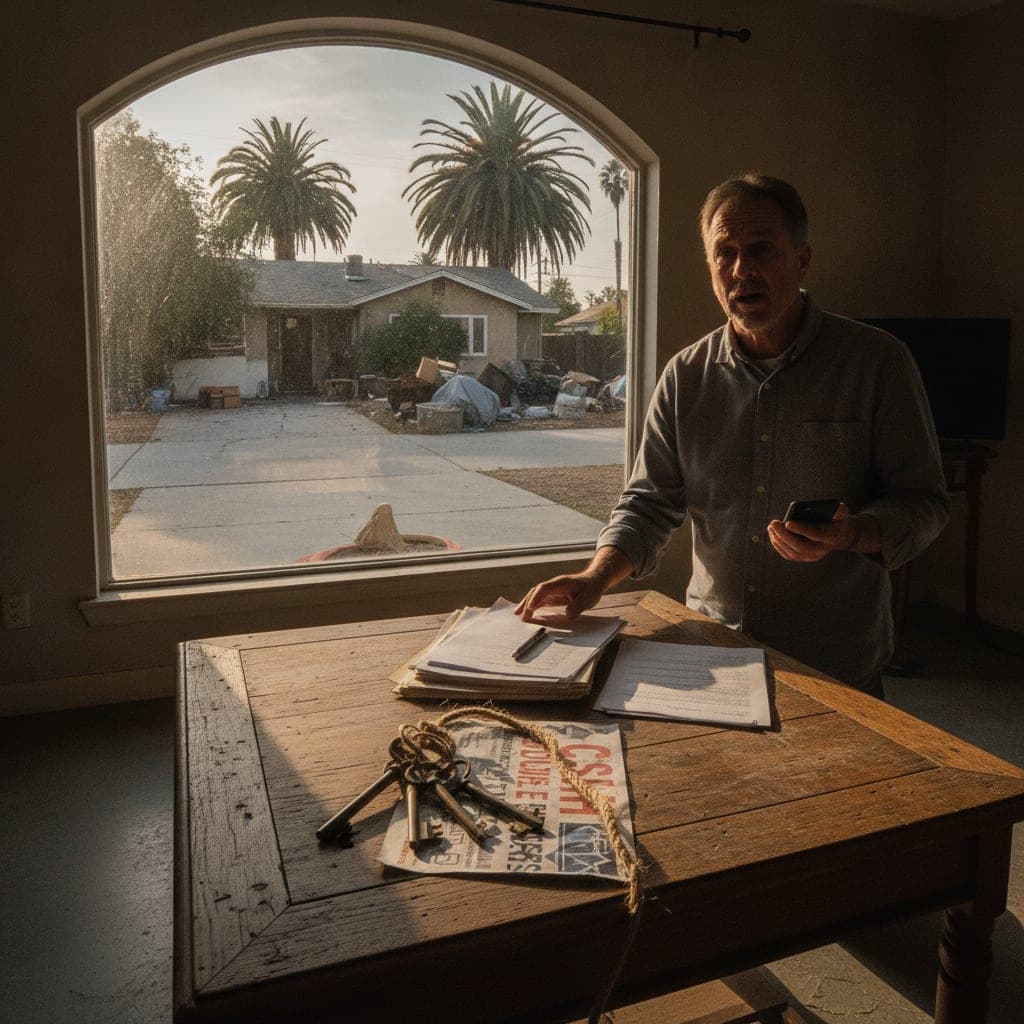

If you need to sell a fire damaged house in California, you have three real paths and the right one depends on damage tier, insurance policy type, and how much time you can spend rebuilding. The short answer most sellers eventually land on: a cash sale of the as-is structure plus the insurance proceeds you have already collected typically nets 50 to 75 percent of pre-fire after-repair value, in 30 to 60 days, with no rebuild risk. A full rebuild can net more on paper but takes 12 to 30 months in 2026 California fire-zone permitting, with real cost overruns. This guide lays out the math on each path so you can decide.
This is a sensitive topic. If you are reading this because your home burned in the 2025 LA wildfires or anything since, we are sorry. The information here is general, it is not insurance, tax, or legal advice. Talk to your adjuster, a CPA, and a real estate attorney before signing anything.
The three paths to sell a fire damaged house in California
Every seller of a fire damaged home for sale in California ends up at one of three doors:
- Rebuild with insurance proceeds, then sell on the open market. You collect the dwelling-coverage check, hire a general contractor, rebuild to current code, and list the finished home. Maximum gross sale price, longest timeline, highest execution risk.
- Sell as-is to a cash buyer. You keep whatever insurance has already paid out (smoke remediation, additional living expense, partial dwelling proceeds), and sell the standing structure plus lot in current condition. 30 to 60 days, no rebuild, predictable net.
- Sell at lot value if the structure is a total loss. The buyer is paying for dirt plus permits plus the option to rebuild. Common after total-loss wildfire events. The fastest path when there is nothing meaningful left to repair.
Most sellers we see with partial damage net the most by combining options, collect the insurance, then sell the as-is structure for cash. We will work through the numbers on a real example below. For the as-is path specifically, see we buy houses as-is.
Damage tiers: smoke-only, partial, total loss
The path that makes sense for you depends almost entirely on what tier of damage your home suffered.
Smoke-only / cosmetic. No structural damage. Smoke and soot through HVAC, drywall, carpet, drapes, and contents. Remediation runs $15,000 to $80,000 in California depending on square footage. The home is fully habitable after professional remediation. A smoke damage selling house scenario is the easiest to underwrite, many cash buyers will take it within 5 percent of pre-fire ARV.
Partial structural. One or more rooms gutted. Roof partially damaged. Framing intact in most of the structure. Habitability triggered until rebuild of the affected area. Remediation plus rebuild typically $120,000 to $400,000 in 2026 California pricing. This is the bracket where the math gets interesting and the rebuild-vs-cash decision actually matters.
Total loss. Slab and chimney remain, plus possibly a partial wall. Standard outcome of a wildfire interface event. The home is not a home anymore; it is a permitted lot with debris. Sale becomes a lot-value transaction. We cover this in the condemned and unsafe-structure path.
Your insurance policy is the most important variable
Before deciding anything, pull out your declarations page and find two things:
Coverage type, ACV vs RCV. Actual Cash Value (ACV) policies pay you depreciated value. A 25-year-old roof gets paid as a 25-year-old roof, not as a new roof. Replacement Cost Value (RCV) policies pay full replacement cost up to your dwelling limit. RCV pays substantially more in a partial or total loss. Most California homeowners with mortgages have RCV; older or unmortgaged homes sometimes still carry ACV.
Dwelling limit. This is the cap on what your insurer will pay to rebuild the structure. In post-2017 California many homeowners are underinsured, dwelling limits set five years ago at $400 per square foot do not rebuild a 2026 home that runs $550 to $800 per square foot in fire-hardened construction.
Additional Living Expense (ALE). Pays your alternative housing while the home is uninhabitable. Typically 12 to 24 months. ALE is not affected by selling the structure, but the timeline can be, read your policy carefully or ask your adjuster.
The critical insight: insurance proceeds for a partial loss are paid to you as the homeowner. You can collect them, then sell the damaged structure as-is. The insurer does not claw back the dwelling-coverage payment because you chose not to rebuild. (For a total loss with a mortgage, the lender controls disbursement, different rules.) That structure is what makes a sell house after fire California cash sale net so well: insurance pays for the damage, the cash buyer pays for the lot plus residual structure, and you keep the spread.
This is general information, not insurance advice. Read your policy and confirm with your adjuster.
The 2026 California rebuild reality
If you are considering rebuilding before selling, the 2026 timeline math is the part nobody tells you in the first month after the fire.
Permitting: 4 to 12 months in most CA fire-zone jurisdictions, longer in LA County after the 2025 Palisades and Eaton wildfires given the volume of rebuild applications. Plan-check rounds typically run two to four cycles.
Construction: 10 to 18 months once permits are in hand for a single-family rebuild, longer for larger homes or hillside lots requiring re-engineered foundations.
Total elapsed: 14 to 30 months from fire to certificate of occupancy is the realistic 2026 California range. We have seen faster on smaller scopes with a strong GC and slower in jurisdictions still backlogged from prior wildfire seasons.
Cost overruns: Industry rule of thumb is 15 to 25 percent over the original GC bid. Material costs and labor have been moving in 2025 to 2026. If your insurance covers $385,000 of rebuild and the actual rebuild lands at $445,000, you fund the gap.
Carrying cost: During rebuild you are paying property tax, insurance on a vacant lot, and any mortgage servicing on a structure that does not exist. Two years of carrying cost on an $850,000 Pasadena property easily runs $40,000 to $60,000 even with ALE covering the rent on your alternative housing.
For sellers who do not have the financial cushion or temperament for a 24-month construction project, a wildfire damaged property California cash sale is a rational choice even when the rebuild path looks better on a spreadsheet.
AB 38 and Chapter 7A: what rebuilding to code now costs
If you rebuild in a designated Fire Hazard Severity Zone, you are rebuilding under California Building Code Chapter 7A, the home-hardening standard. Class A roofing, ignition-resistant siding, ember-resistant vents, tempered windows or shutters, defensible-space landscaping. Required in any Very High FHSZ and increasingly in High zones.
Real-world cost premium versus the 2005-era code your old home was built under: $40,000 to $120,000 on a typical single-family rebuild in 2026. Some of this is offset by lower future insurance premiums under California's new mitigation-discount framework, but the upfront cash hit is real.
AB 38 also adds a disclosure requirement when selling a home located in a high or very high FHSZ, buyers must receive documentation of compliance with defensible-space and home-hardening requirements at time of sale. We cover this in detail in the AB 38 wildfire disclosure guide.
Disclosure: fire history must be disclosed
California Civil Code §1102 requires a Transfer Disclosure Statement (TDS) on most residential resales. Material facts about the property, including prior fire damage, smoke remediation, and any unrepaired damage, must be disclosed. The TDS is not optional and you cannot disclaim it via "as-is" language. See the seller disclosures guide for the full TDS and NHD breakdown.
The practical implication: any buyer, cash or retail, will know the home had a fire. There is no upside to under-disclosing. A clean disclosure plus the remediation invoices and any insurance documentation actually helps a cash buyer underwrite faster, because they can see exactly what was done.
For situations where there are also unpermitted repairs, work done without permits during DIY remediation, or open code violations from the fire damage, see the code-violations situation page.
Worked example: $850k Pasadena partial-damage home
Real-shape numbers, anonymized. Pre-fire ARV $850,000 (a 1,650 sq ft three-bedroom in Pasadena, 2024 sale comp basis, adjusted for current market). Partial fire damage to the kitchen, dining room, and roof. Insurance is RCV with a $620,000 dwelling limit and $90,000 ALE. Adjuster issues a $310,000 dwelling-coverage check after settlement.
Path A: rebuild and sell.
- Insurance check: $310,000
- Actual rebuild cost (GC bid plus 18 percent overrun): $385,000
- Out-of-pocket rebuild gap: $75,000
- Carrying costs over 24 months (tax, insurance, mortgage servicing net of ALE): $48,000
- Sale price after rebuild (back to pre-fire ARV, $850,000, in 2028 market): $850,000
- Selling costs (5.5 percent agent + closing): $46,750
- Net proceeds: $850,000 minus $46,750 equals $803,250
- Subtract rebuild gap and carrying cost: $803,250 minus $123,000 equals approximately $680,250 net, after 24 months.
- Tax note: rebuilding restarts your basis math. A CPA should advise on §1033 involuntary-conversion treatment of insurance proceeds.
Path B: collect insurance, sell as-is for cash.
- Insurance check: $310,000 (already in your bank)
- Cash offer on as-is partial-damage structure plus lot: $475,000
- Selling costs (cash buyer pays closing, no agent): $0
- Net cash proceeds: $475,000
- Plus retained insurance proceeds: $310,000
- Combined net: approximately $785,000, in 45 days.
Path B nets more, faster, with no rebuild risk. The arithmetic favors this combination in most partial-damage situations because the cash buyer is underwriting only the residual lot plus structure value, not the gap between insurance settlement and full reconstruction. It does not always win, if your insurance settled low or your dwelling limit was inadequate, the calculation can flip, but for a properly insured partial loss it is the path that pencils.
This is illustrative math, not a guarantee. Your numbers will differ. Get an actual cash offer and compare it against your actual insurance settlement before deciding.
Lot-value sales when the structure is a total loss
When the structure is a total loss, slab plus chimney plus debris, the transaction is no longer about a house. The buyer is paying for:
- The lot itself (dirt value, location, view, parcel size)
- An existing approved address and utility connections
- The right to rebuild under existing zoning
- In many post-fire areas, expedited permit pathways for like-for-like rebuilds
In LA County after the 2025 wildfires, lot values in established neighborhoods like Pacific Palisades held a meaningful share of pre-fire whole-property value because the underlying land was always the larger component of price. In more rebuild-cost-heavy areas like inland Riverside and San Bernardino, the lot is typically a smaller share of total value and the price drop after total loss is steeper.
A burned house cash buyer evaluating a total-loss parcel will look at: comparable lot sales in the same neighborhood, debris-removal cost (often state-funded post-disaster, sometimes not), Phase 1 environmental concerns, and the cost to bring in a buildable-condition foundation. Offers in the $200,000 to $600,000 range for non-coastal LA-area total-loss lots are common in 2026; coastal premiums push much higher.
If the property has been red-tagged or condemned post-fire, see the condemned property path. For sales where the property is structurally sound but you simply want it gone in any condition, the any-condition path covers the broader case.
Red flags specific to fire-situation cash buyers
Fire situations attract a particular kind of bad-faith buyer, the insurance-proceeds chaser. Watch for:
The "sign over your insurance proceeds" pitch. A legitimate cash buyer prices the as-is structure and lot. They do not need or want your insurance check. If a buyer asks you to assign your insurance claim to them as part of the purchase, walk. The insurance proceeds are yours. Selling the damaged structure does not require giving them up.
The post-disaster door-knocker. In the days after a wildfire, predatory operators canvass affected neighborhoods with low-ball offers and high-pressure tactics targeting traumatized homeowners. California has post-disaster cooling-off rules but enforcement is uneven. Take 30 days minimum before signing anything after a fire.
The "we will deal with the insurance company for you" offer. Public adjusters are licensed and useful. "Cash buyers" who promise to handle your insurance claim are typically neither licensed adjusters nor legitimate buyers. Two separate transactions, two separate professionals.
The vague proof of funds. Same playbook as in any cash sale. We covered the broader pattern in the we-buy-houses ripoff guide. Fire-damaged sellers are particularly vulnerable to it. Same defenses apply: dated proof of funds, capped inspection window, no assignment clause, neutral escrow.
Pricing far above other offers on the same property. A bait offer is a bait offer regardless of context. If three buyers are at $470,000 and one is at $560,000, the $560,000 buyer is planning to renegotiate after they have locked you up.
For the broader vetting framework, see are cash home buyers legit and the California fast-sale guide.
A clean as-is offer on a fire damaged property
If your home suffered fire damage and you want to compare what a clean cash offer looks like against the rebuild math, keep your insurance proceeds, sell the as-is structure on a hard 30 to 45 day timeline, no assignment clause, no inspection renegotiation games, get your offer. Twenty-four-hour turnaround on damaged-property pricing. We will send the comp set and the repair scope assumptions in writing, so you can stack it directly against your insurance settlement and the rebuild path. Take it, leave it, or use it as a benchmark while you decide. The right path for your specific situation is whichever one nets you the most for the time and risk you can carry, and you should not have to commit to that decision before you see the actual numbers.
Common questions
Questions people ask about this
- Can I sell a fire damaged house in California while my insurance claim is still open?
- Yes, in most cases. A partial-loss claim can remain open while you sell the structure as-is, you continue to receive proceeds you are owed. A total-loss claim with a mortgage typically requires lender coordination because the lender is named on the dwelling-coverage check. Confirm the structure with your adjuster and lender before listing.
- Do I have to disclose the fire if it was years ago and fully repaired?
- Yes. California's TDS asks specifically about prior damage and repairs. "Material facts" includes fire history regardless of how long ago. The good news: a fully documented repair with permits and final inspections actually helps the sale, because the buyer can see the work was done correctly. See the AB 38 and seller-disclosure guides for specifics.
- Will a cash buyer pay more if I do basic remediation first?
- Sometimes. Smoke-and-soot remediation through a licensed restoration company often pays back more than its cost in a cash offer because it lets the buyer underwrite the structure without modeling worst-case smoke damage. A $35,000 remediation that lifts the offer by $55,000 is worth doing. Full rebuild before sale almost never pencils versus selling as-is.
- What if my house is in Riverside or San Bernardino, not LA?
- The cash-buyer market is active across SoCal fire zones. We cover Riverside and San Bernardino directly, plus inland markets like Corona, Hemet, and Moreno Valley. Inland lot-value math is different from LA-area math but the path-A-versus-path-B logic is the same.
- Are there tax implications I should know about?
- Yes, and they matter. California and federal tax law treat insurance proceeds for involuntary conversions (including fire) under IRC §1033, which can let you defer gain if you reinvest within a window. Selling the structure rather than rebuilding can change that treatment. This is not tax advice, talk to a CPA who has done fire-loss filings before, ideally one who has worked the post-2017 California wildfire seasons.
- My home is in Pasadena / Thousand Oaks / Simi Valley, does the LA fire context still apply?
- For Pasadena, yes, directly, Eaton-fire-affected neighborhoods are in the same permitting and rebuild bottleneck. For Thousand Oaks and Simi Valley, the macro market is similar but local FHSZ designation and individual jurisdictional permitting timelines vary. Talk to a local cash buyer who actually closes deals in your specific city. We cover Los Angeles and San Diego markets directly as well, plus inland zones like Escondido.
Written by
Adrian HernandezCEO/Owner, My Home Sold
Adrian Hernandez founded My Home Sold in 2015 and has led it through more than 900 direct home purchases across Southern California. He has appeared on FOX 11 Good Day LA discussing the shift in the Southern California market and what it means for homeowners whose listings are not moving.
More about AdrianReady to Get Started?
Contact us today to learn how we can help you.