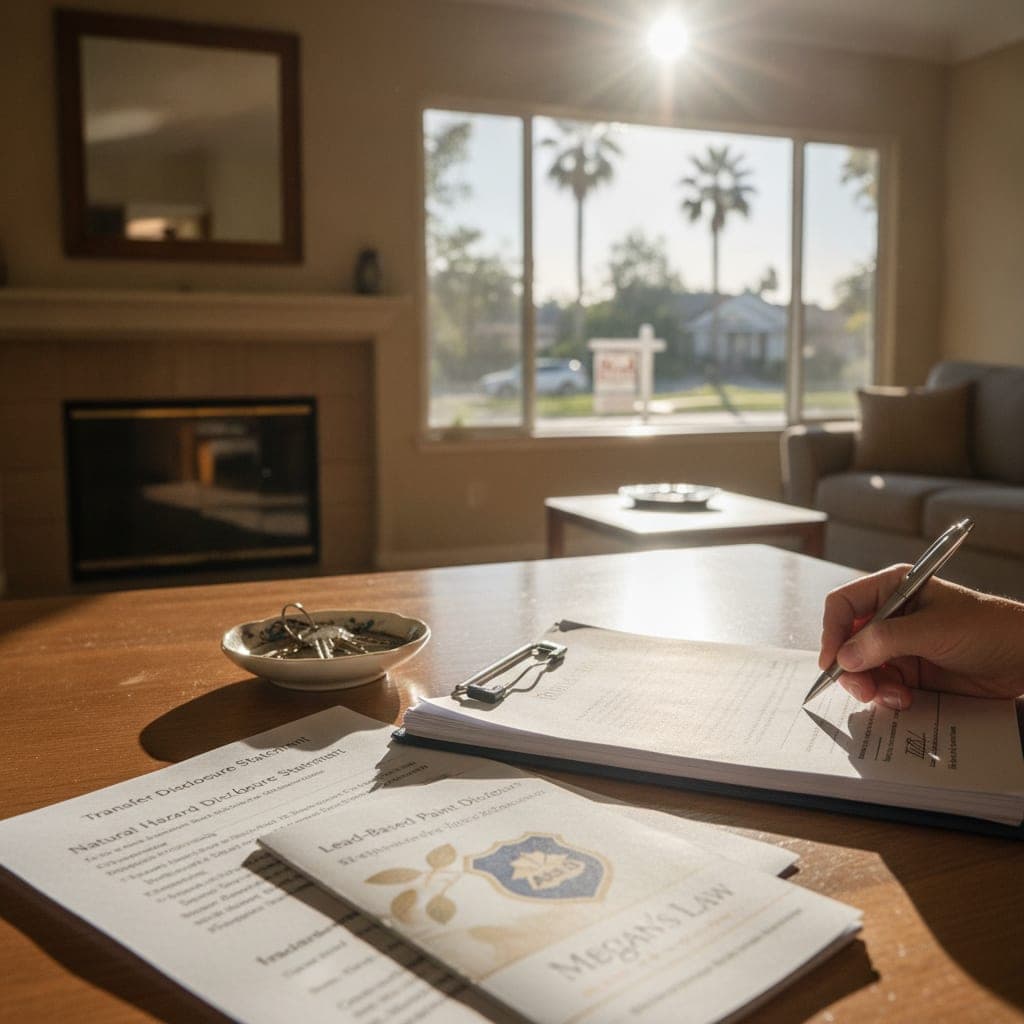
The short answer: the ab 38 wildfire disclosure law (Government Code §51182) requires sellers of homes built before 2010 in a designated High or Very High Fire Hazard Severity Zone to disclose specific home-hardening features, provide compliance documentation where available, and deliver the package within 6 days of acceptance. If the home transferred on or after July 1, 2021, the seller must also provide documentation of compliance with state defensible-space and home-hardening requirements. None of this can be waived by selling "as-is" or by selling for cash. This guide walks through who is in scope, the 12 hardening items, the defensible-space inspection, what it actually costs, and how a cash sale changes the math.
Who AB 38 applies to
The ab 38 wildfire disclosure obligation only attaches when three conditions are all true:
- The home was built before January 1, 2010.
- The home is located in a High or Very High Fire Hazard Severity Zone (FHSZ) as mapped by CalFire (state responsibility area) or the local fire authority (local responsibility area).
- The home is being sold or transferred (purchase contracts entered after the AB 38 disclosure provisions took effect on January 1, 2021).
If any one of those is false, AB 38 does not apply. A 2015 build is out. A pre-2010 build in a Moderate FHSZ is out (although a separate Natural Hazard Disclosure still applies). A pre-2010 build in a Very High FHSZ in Riverside County, San Bernardino, Thousand Oaks, or Simi Valley is squarely in scope, and tens of thousands of homes in each city qualify.
The authoritative map is CalFire's FHSZ viewer. Local jurisdictions sometimes designate additional Very High zones beyond what the state maps, so a parcel that looks safe on the state map may still be in scope through a local ordinance.
The 12 home-hardening disclosure items
The ab 38 wildfire disclosure form asks the seller to certify, for each of the following categories, whether the feature complies with current California Building Code Chapter 7A standards (Health & Safety Code §13108 et seq., implemented through Building Code Chapter 7A for wildland-urban interface construction):
- Eaves and soffits, enclosed, ignition-resistant
- Exterior siding, non-combustible or ignition-resistant
- Roof covering, Class A fire-rated
- Roof gutters, non-combustible, with leaf guards
- Vents, ember-resistant (1/8" to 1/16" mesh, listed assemblies)
- Windows, multi-pane, tempered exterior glazing
- Exterior doors, solid core or fire-rated
- Decks, porches, balconies, ignition-resistant materials
- Underfloor enclosure, non-combustible skirting where applicable
- Chimney and fireplace, spark arrestor with proper mesh
- Detached structures within 50 feet, disclosed condition and materials
- Defensible space compliance, yes/no, with documentation
For each item the seller marks compliant, non-compliant, or unknown. Sellers are not required to retrofit, only to disclose. Buyers then decide whether to negotiate repairs, walk, or proceed.
The disclosure form is typically delivered as part of the broader Natural Hazard Disclosure (NHD) report packet from a third-party provider, but it is a distinct statutory document. Do not assume the standard NHD covers it without checking, older NHD templates may not include the full AB 38 stack.
PRC 4291 defensible space: zones 0, 1, and 2
Public Resources Code §4291 requires 100 feet of defensible space around any structure in a State Responsibility Area or Very High FHSZ in a Local Responsibility Area. The space is broken into three zones:
- Zone 0 (0–5 feet from the structure): ember-resistant zone. No combustible mulch, no woody plants, no stored fuel, no fences attached to the home in combustible materials. This zone is the most recently codified (regulatory adoption finalized 2023–2024) and is the one most homes fail.
- Zone 1 (5–30 feet): "lean, clean, and green." Trimmed plants, no dead vegetation, no firewood piles, tree canopies separated from the structure by at least 10 feet.
- Zone 2 (30–100 feet): reduced fuel zone. Grass mowed to 4 inches, downed wood removed, tree canopy spacing rules apply, surface fuels broken up.
A local fire authority inspection (CalFire or the city/county fire department) generates a PRC 4291 inspection report. That report is the documentation a seller is asked to produce when the buyer requests defensible-space compliance evidence under AB 38.
What the seller actually has to deliver
Within 6 days of acceptance of the purchase contract, the seller must deliver to the buyer:
- The completed AB 38 home-hardening disclosure form (Govt. Code §51182).
- Documentation of compliance with PRC 4291 defensible space, typically a recent inspection report from the local fire authority. If the home has not been inspected, the seller discloses that fact and the buyer may request a pre-close inspection.
- The Natural Hazard Disclosure (NHD) statement, which separately confirms the FHSZ designation.
- Any prior compliance documentation in the seller's possession, receipts for re-roofs to Class A, vent retrofits, window replacements, inspection sign-offs.
The disclosure cannot be waived. Buyers and sellers cannot agree to skip it, even in a clearly-disclosed as-is transaction. This is a recurring point of confusion that we cover on seller disclosures California TDS NHD.
Does AB 38 apply to as-is and cash sales?
Yes. The ab 38 wildfire disclosure is a statutory disclosure and cannot be contracted around. A buyer can agree to take the property in its current condition and waive their right to negotiate repairs, but they cannot waive their right to receive the disclosure itself. The same applies to we buy houses as-is cash transactions, the buyer takes the property in current condition, but the seller still completes and delivers the AB 38 form.
What does change in a cash sale: the buyer is typically not asking for repairs based on the disclosure. A reputable cash buyer underwrites the property assuming all 12 hardening items are non-compliant and prices accordingly. They are not going to come back after inspection and demand a $25,000 vent and roof retrofit credit. That is one of the structural advantages of selling for cash in California when the property is in a fire zone, the disclosure happens, but the transaction does not get re-traded over hardening.
This is also where the /blog/sell-code-violation-property-in-california lane intersects. If the property has open code or fire-marshal compliance items, failed defensible space inspection, citations from the local fire authority, work done without permits, those issues stack on top of AB 38 disclosure obligations and can stall a retail sale entirely while a cash buyer absorbs them.
Worked example: 1985 Riverside County home in Very High FHSZ
The property: 3-bedroom, 1,650 sqft, 1985 build, foothills west of Riverside, Very High FHSZ on the CalFire map. Original wood shake roof was replaced with composition shingle in 2003 (not Class A). Original wood siding. Original single-pane windows. Wood deck on the back. No defensible space inspection on file.
AB 38 wildfire disclosure findings: 8 of the 12 items return non-compliant or unknown. Compliant: gutters (recent replacement), chimney spark arrestor, detached structures (none within 50 feet), exterior doors. Non-compliant: roof, siding, vents, windows, deck, eaves, underfloor, defensible space.
Retail buyer's repair credit demand: A retail buyer with conventional financing typically asks for a credit covering the highest-cost compliance items so their lender will close. Class A roof replacement runs $14,000–$22,000, ember-resistant vent retrofit $1,500–$3,500, dual-pane window replacement (12 windows) $9,000–$15,000, and a Zone 0 cleanup with deck modification $2,500–$6,000. Total realistic ask: $27,000 to $46,500, often consolidated into a $30,000 credit demand.
Insurance angle: The seller's existing carrier non-renewed in 2024. The buyer's quote from the FAIR Plan came in at $4,800 a year, and a private carrier required Class A roof and ember-resistant vents as a condition of writing the policy at all. Without that retrofit, the buyer cannot obtain the insurance their lender requires. The deal stalls.
Cash buyer outcome: The seller takes a cash offer at $445,000 against an after-retrofit retail value of around $520,000. The buyer absorbs the $30,000+ retrofit cost, the FAIR Plan exposure during the hold period, and the insurance underwriting risk. Net to the seller after a 14-day close: approximately $445,000 minus property tax proration, no concessions, no credits. Net to the seller in the retail scenario after credits, agent commission, and 60+ days of carrying costs: often within $10,000 to $20,000 of the cash number, with much more execution risk.
The insurance and lender problem
The second-order effect of the ab 38 wildfire disclosure regime is the insurance market. Beginning around 2022, California carriers tightened underwriting on FHSZ properties. By 2025, several major carriers stopped writing new policies in High and Very High zones entirely. Home-hardening compliance, specifically Class A roofs, ember-resistant vents, and Zone 0 defensible space, is increasingly the gate to obtaining any private-market policy.
The practical consequence for sellers: even if the buyer is willing to accept the disclosure and proceed, their lender requires an active insurance policy, and the insurer requires hardening compliance. A non-compliant pre-2010 home in a Very High FHSZ can be effectively unfinanceable on the retail market without a retrofit, regardless of the buyer's intent. This is why cash buyers in California have absorbed an increasing share of FHSZ transactions, they do not need lender approval and they do not need a private-carrier insurance binder at close.
Penalties and buyer remedies for non-disclosure
Failure to deliver the ab 38 wildfire disclosure does not trigger an automatic statutory penalty. The remedies sit inside contract law. If the buyer discovers post-close that the seller knew the property was non-compliant and failed to disclose, the buyer can sue for actual damages, typically the cost to bring the property into compliance, plus consequential damages such as insurance premium increases or denial of coverage. In bad-faith cases, punitive damages and attorney's fees are available.
The California Department of Insurance and the California Department of Real Estate both accept consumer complaints related to wildfire disclosure failures. Local fire authorities can also issue PRC 4291 violation notices that attach to the property record and survive the sale.
The practical takeaway: complete the disclosure honestly, even if items are non-compliant. "Unknown" is an acceptable answer when it is true. "Compliant" when it is not is what creates the lawsuit risk.
A clean cash offer on a fire-zone home
If your home is in a High or Very High FHSZ, was built before 2010, and you do not want to spend $30,000+ on a hardening retrofit to make it financeable on the retail market, get your offer. 24-hour turnaround. We absorb the disclosure complexity, the insurance underwriting risk, and the retrofit cost. You get a number, a close date, and a clean exit.
Common questions
Questions people ask about this
- Does the ab 38 wildfire disclosure apply if my home was built in 2009?
- Yes. The cutoff is January 1, 2010, pre-2010 builds in a High or Very High FHSZ are in scope. A 2009 build is in scope. A 2010 build that received its certificate of occupancy after January 1, 2010 is generally out of scope, though new-build wildland-urban interface (Chapter 7A) standards already applied to it.
- Can I sell without retrofitting to comply?
- Yes. AB 38 is a disclosure law, not a retrofit mandate. The seller is required to disclose what is and is not compliant. The buyer decides whether to demand repairs, accept the property as-is, or walk. A cash buyer typically accepts as-is and absorbs the retrofit risk in the offer price.
- What if my local fire authority has not done a PRC 4291 inspection?
- Disclose that fact on the form. The buyer can request a pre-close inspection through the local authority. CalFire and most local fire departments offer the inspection for free or for a nominal fee. Scheduling can take 2 to 6 weeks, which is part of why it matters whether your buyer is on a 14-day cash timeline or a 45-day financed timeline.
- Is the ab 38 wildfire disclosure separate from the Natural Hazard Disclosure (NHD)?
- Yes. The NHD identifies whether the property sits in a designated zone (FHSZ, flood, earthquake fault, etc.). The AB 38 disclosure is the property-specific home-hardening checklist that follows once the NHD confirms a High or Very High FHSZ designation. Most NHD providers package both, but they are statutorily distinct.
- Do these rules vary by county?
- Yes. Local fire authorities can adopt stricter standards, including additional Very High FHSZ designations beyond the state map and additional defensible space requirements. Always confirm with the local jurisdiction (often the county fire marshal or the city building department) before relying solely on the state map. This guide is informational and not legal advice; consult a California real estate attorney or your local fire authority for property-specific compliance questions.
Written by
Adrian HernandezCEO/Owner, My Home Sold
Adrian Hernandez founded My Home Sold in 2015 and has led it through more than 900 direct home purchases across Southern California. He has appeared on FOX 11 Good Day LA discussing the shift in the Southern California market and what it means for homeowners whose listings are not moving.
More about AdrianReady to Get Started?
Contact us today to learn how we can help you.