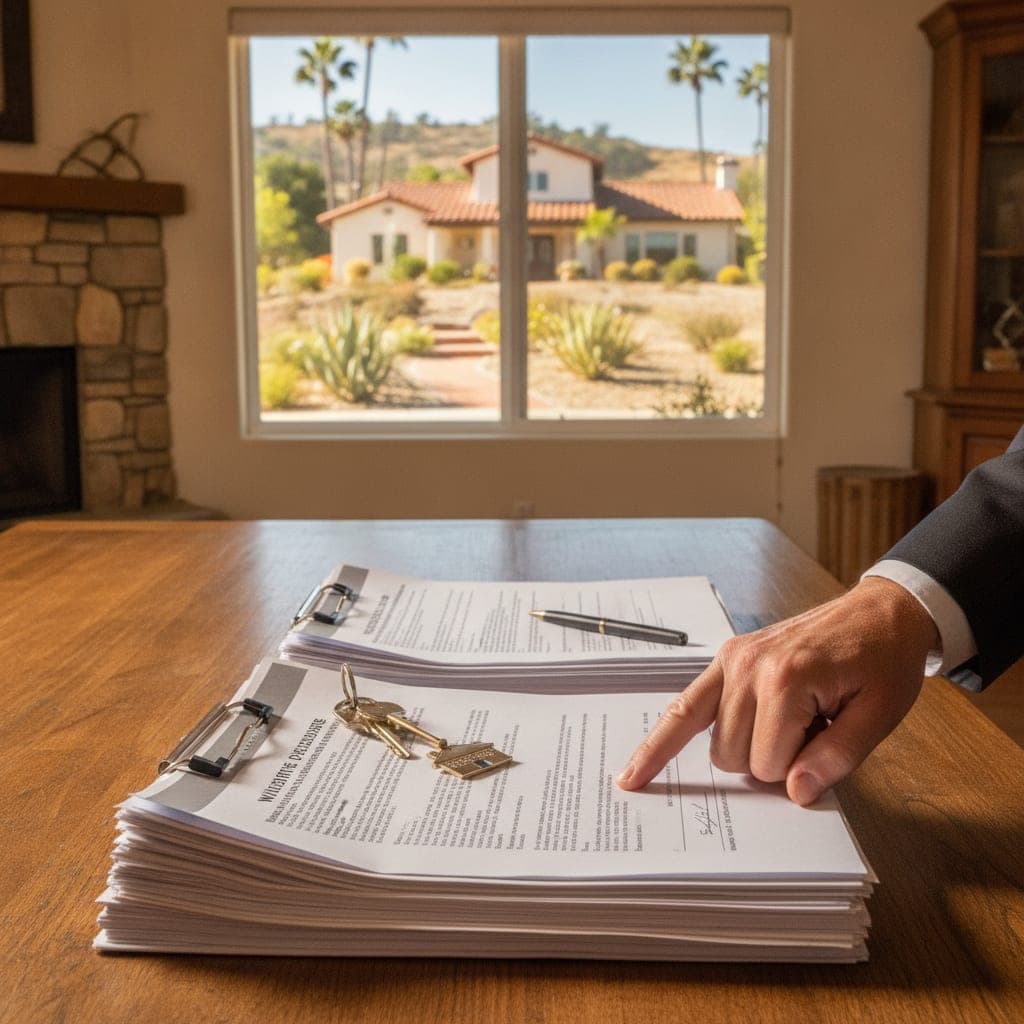
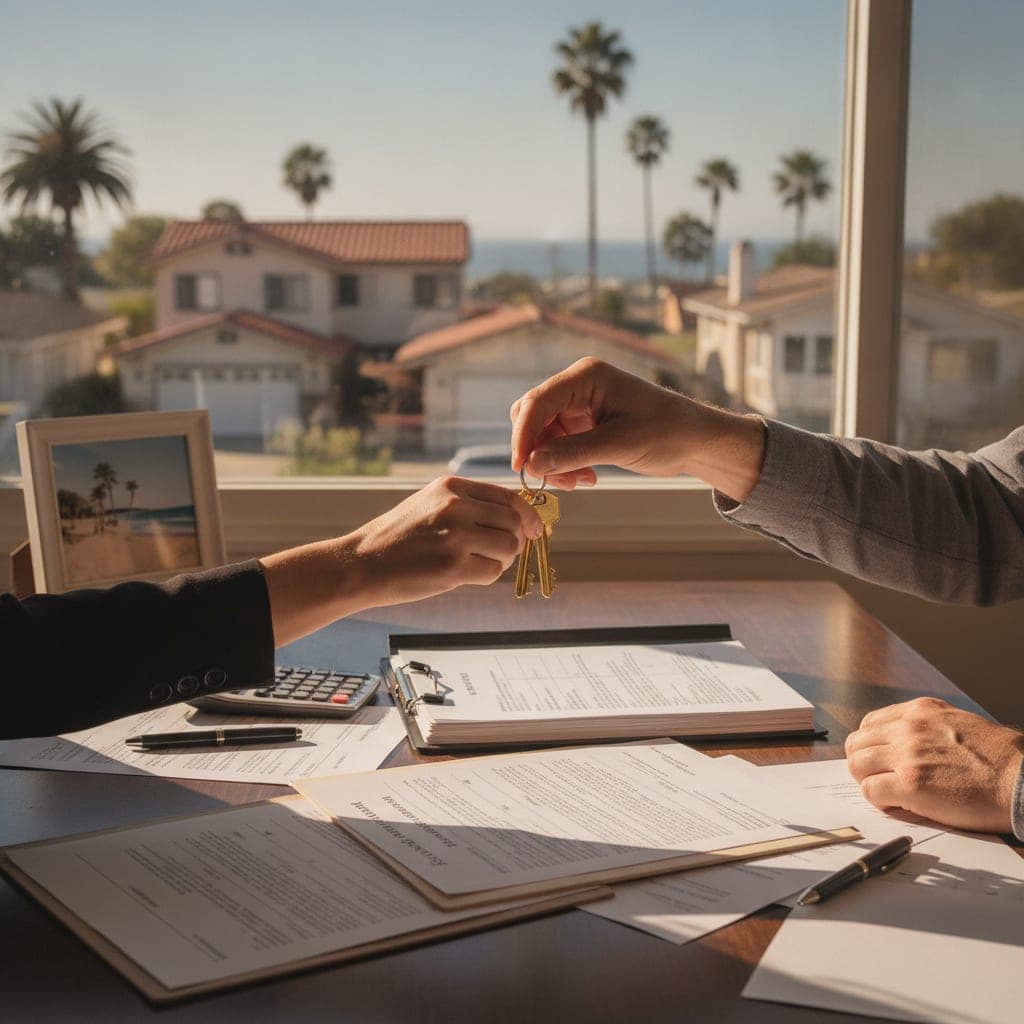
The california escrow process typically runs 30 to 45 days for a financed deal and 7 to 21 days for a cash deal. The variation is not random, it is driven by which of 11 specific milestones the transaction has to clear, and how long each one takes. This guide walks the timeline day by day, lists who pays what, and shows the line-item closing-cost math on a real $750,000 Long Beach sale.
The other thing worth saying up front: California is an escrow state, not an attorney state. Escrow is handled by independent licensed escrow companies under California Financial Code §17000 et seq. not by the buyer's or seller's attorney, the way it works on the East Coast. The escrow holder is a neutral third party. They do not represent either side. They follow the joint instructions in the purchase contract and disburse funds at close.
How long does escrow take in California?
The california escrow process statewide average is about 35 days for a financed purchase and 14 days for an all-cash purchase. The California Association of Realtors Residential Purchase Agreement (CAR RPA) defaults to a 30-day close, with contingencies stacked at 17 days for inspection and 21 days for loan and appraisal. Buyers and sellers can shorten or lengthen those windows by agreement, but most financed deals hold roughly to the defaults.
Northern California and Southern California run the california escrow process slightly differently. SoCal counties (Los Angeles, Orange, San Diego, Riverside, San Bernardino) typically have the seller pay the owner's title insurance policy. NorCal counties (Alameda, Contra Costa, San Francisco) often split title and escrow fees differently by local custom. The legal framework is the same; only the customary cost split varies.
If you are selling for cash in California, you can skip every step tied to financing, appraisal, loan contingency, lender conditions, which is what compresses the timeline from 35 days down to 7 to 14.
The 11 steps in the california escrow process
The california escrow process breaks down into eleven distinct milestones, each with a default trigger date in the CAR RPA:
- Open escrow and earnest money deposit (day 1-3)
- Preliminary title report ordered (day 1-7)
- Disclosures delivered (day 1-7)
- Inspection contingency (default 17 days)
- Appraisal (financed only, day 7-21)
- Loan contingency removal (default 21 days)
- Final walkthrough (5 days before close)
- Signing day (notary, grant deed, closing statement)
- Funding and recording (close of escrow)
- Possession (per contract)
- Final settlement statement (days after close)
Missing a date does not automatically kill the deal, but it does shift contractual leverage in the california escrow process. Sellers should track every date.
Step 1: Open escrow and earnest money deposit
Day 1 to 3. Once the purchase contract is signed, the buyer wires the earnest money deposit (EMD) to the escrow company. In California, EMD is typically 1 to 3 percent of purchase price. On a $750,000 home, expect $7,500 to $22,500 in earnest money sitting in the escrow trust account.
The escrow officer assigns a file number, sends opening instructions to both sides, and orders the preliminary title report. The escrow agent's neutral role is governed by Civil Code §2924 and the Escrow Law (Fin. Code §17000 et seq.), they cannot release funds without joint instructions or a court order.
Step 2: Preliminary title report
Day 1 to 7. The title insurer pulls every recorded document affecting the property: deeds, deeds of trust, mechanics liens, tax liens, easements, CC&Rs, judgment liens, and any unreleased lis pendens. The preliminary report ("prelim") goes to both sides for review.
The prelim is where most title surprises surface. An old deed of trust that was never reconveyed. A judgment lien from a 2009 lawsuit. A sibling on the deed because of an inheritance the seller forgot to clear. If you are dealing with title or deed issues or an inherited property, the prelim is the moment of truth, and the moment to start clearing problems.
Step 3: Disclosures delivered
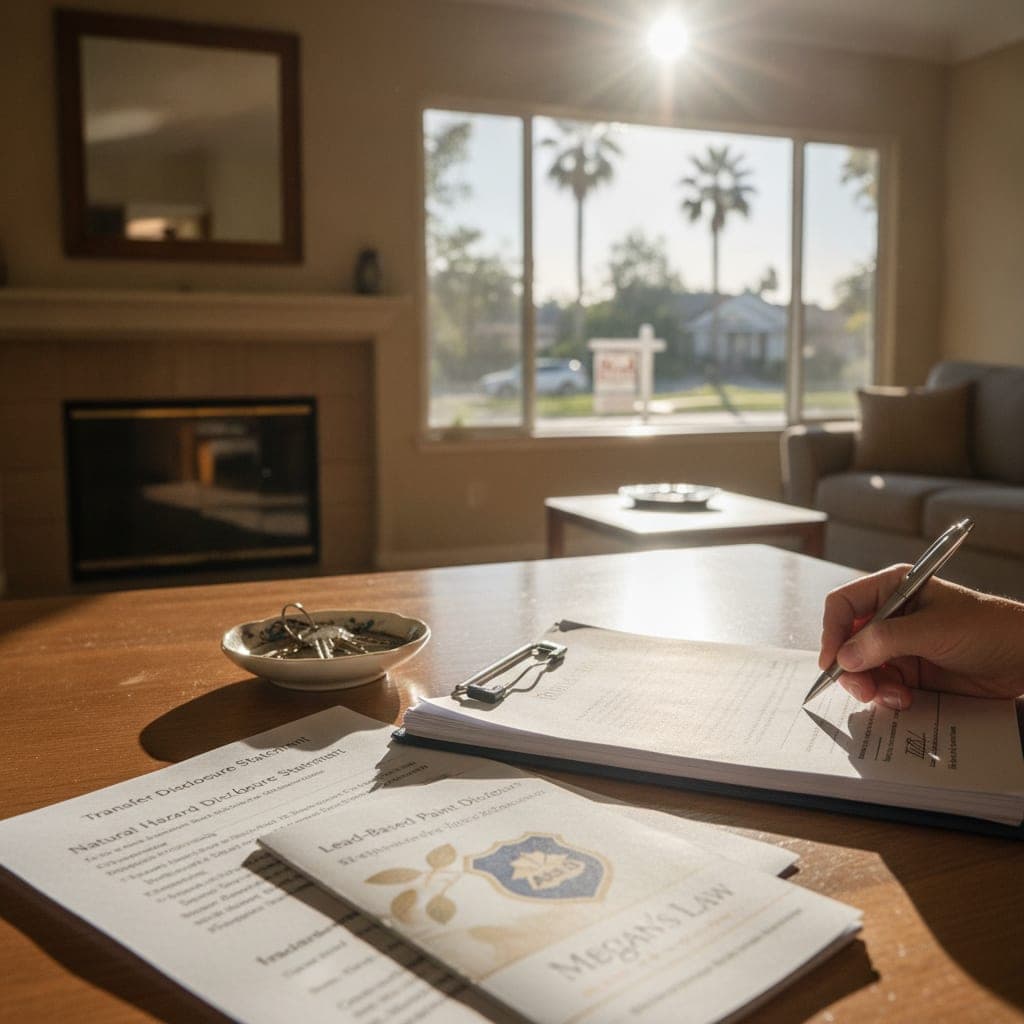
Day 1 to 7. California has the longest disclosure list in the country. The seller delivers:
- Transfer Disclosure Statement (TDS), Civil Code §1102
- Natural Hazard Disclosure (NHD), flood, fire, earthquake, seismic
- Lead-based paint disclosure (homes built before 1978)
- Megan's Law database notice
- Carbon monoxide and smoke alarm compliance certification
- HOA documents if applicable (Civil Code §4525)
- Mello-Roos and 1915 Act bond disclosures
- Water heater strapping and earthquake-related disclosures
The buyer has three days after delivery to disapprove TDS/NHD and back out. Most cash buyers waive most disclosures or accept the property as-is, which is why cash sales close so much faster.
Step 4: Inspection contingency
Days 1 to 17 (default). The buyer orders a general home inspection, plus any specialty inspections (sewer scope, roof, foundation, mold, termite). In California, the termite report is usually a separate "Wood Destroying Pest" (WDP) inspection per Section 1 (active infestation) and Section 2 (conditions likely to lead to infestation).
The buyer can request repairs, request a price reduction, or cancel for any reason during the inspection window. At day 17 the buyer must remove the inspection contingency in writing or the seller can issue a Notice to Perform and cancel after another 48 hours.
Reputable California cash home buyers typically run a 5 to 7 day inspection contingency, not 17. A long inspection window is a red flag, see our breakdown on we-buy-houses ripoff tactics.
Step 5: Appraisal
Day 7 to 21 (financed deals only). The buyer's lender orders the appraisal. The appraiser walks the property, pulls comps, and writes a value opinion. If the appraisal comes in below contract price, the buyer either brings extra cash, the seller drops price, or the deal renegotiates.
Low appraisals are the single most common reason a financed California deal falls out of escrow in 2025-2026, partly because rate-sensitive buyers stretched to the contract price and partly because comps in volatile markets like Riverside and San Bernardino lag rapid price moves.
All-cash buyers skip this step entirely. No appraisal contingency, no appraisal-related delay, no renegotiation risk.
Step 6: Loan contingency removal
Day 21 (default). The buyer's lender issues final loan approval and the buyer signs a Contingency Removal form. After this point, the buyer's earnest money is at risk, if they walk for any reason other than a seller-side default, they typically forfeit the EMD.
Financing is where the california closing process most often slips. Underwriting conditions, last-minute employment verification, undisclosed credit pulls, and condo HOA questionnaires can all push loan removal past day 21. Each day of slippage compresses the rest of the calendar.
Step 7: Final walkthrough
5 days before close (typical). The buyer walks the property to confirm it is in the same condition as the offer date, that any agreed-upon repairs are complete, and that all included fixtures are still there. Final walkthroughs rarely kill deals but occasionally surface a missing appliance or unfinished repair that gets credited at close.
Step 8: Signing day
Day 28 to 30 (financed) or day 7 to 14 (cash). Both parties sign their closing documents in front of a notary, typically at the escrow office. The seller signs the grant deed transferring title. The buyer signs the loan documents (financed) or just the closing statement (cash). Both sides sign the final settlement statement (formerly HUD-1, now the ALTA Settlement Statement for cash, Closing Disclosure for financed).
In California most signings happen in person at the escrow office, but mobile notaries and remote online notarization (RON) are increasingly common, especially for out-of-state sellers or relocation sellers who have already moved.
Step 9: Funding and recording
The buyer's funds (cash wire or lender wire) hit the escrow trust account. Escrow disburses to pay off the seller's existing mortgage, pays property tax prorations, pays commissions if any, pays escrow and title fees, pays the documentary transfer tax, and prepares the grant deed for recording.
The deed is sent to the County Recorder. Once it records (same day in most CA counties for documents received before the cutoff), escrow officially closes. The seller's net proceeds wire out, typically same day or next business day.
Step 10: Possession
Per contract, possession typically transfers at recording. Some California contracts include a "seller stay" or rent-back of up to 60 days, often used by sellers who need time to find their next home. Rent-back beyond 60 days converts the arrangement into a tenancy under California landlord-tenant law, which most sellers want to avoid.
Step 11: Final settlement statement
Within a few days of close, the escrow officer issues the final ALTA Settlement Statement showing every line item that flowed through the file. Both sides keep this for tax purposes, it is what your CPA needs to calculate basis, gain, and any §121 primary-residence exclusion or §1031 exchange numbers.
Cash vs. financed escrow timelines
The california escrow process compresses dramatically without a lender in the file. Here is the side-by-side:
| Step | Financed (typical) | Cash (typical) |
|---|---|---|
| Open escrow + EMD | Day 1 | Day 1 |
| Prelim title report | Day 5 | Day 3 |
| Disclosures delivered | Day 5 | Day 3 (often waived) |
| Inspection contingency | Day 17 | Day 5-7 |
| Appraisal | Day 14-21 | N/A |
| Loan contingency | Day 21 | N/A |
| Final walkthrough | Day 25-28 | Day 5-12 |
| Signing | Day 28-30 | Day 7-14 |
| Funding + recording | Day 30-45 | Day 7-21 |
| Total | 30-45 days | 7-21 days |
The financed timeline is mostly waiting on the lender. The cash timeline is mostly waiting on title clearance. If your title is clean, a California cash sale can close in 7 days. If you have title or probate issues, even a cash sale takes 21 to 45 days while the cloud is cleared.
Who pays what in California
Who writes the check for each line item in the california escrow process is set by local custom, not state law, and the split varies by county, but the SoCal default looks like this:
Seller typically pays:
- Owner's title insurance policy
- County documentary transfer tax (Rev. & Tax Code §11911, $1.10 per $1,000 of value)
- City transfer tax (varies, see below)
- Half of escrow fees (split varies)
- HOA transfer/document fees in some counties
- Real estate commissions (if listed)
- Existing mortgage payoff
- Prorated property taxes through close date
- Termite Section 1 work (negotiable)
Buyer typically pays:
- Lender's title insurance policy (financed)
- Half of escrow fees
- Recording fees on grant deed and deed of trust
- Loan origination, appraisal, credit report
- Prorated property taxes from close forward
- HOA initiation/transfer fees in some counties
- Homeowner's insurance prepaid premium
California documentary transfer tax (Rev. & Tax Code §11911)
The county tax is $1.10 per $1,000 of consideration statewide. On a $750,000 sale that is $825. But cities can add their own transfer tax on top. The big SoCal city add-ons:
- Los Angeles (city): $4.50 per $1,000 = $3,375 on $750k. Plus the ULA "mansion tax" of 4% on sales over $5M (and 5.5% over $10M).
- Long Beach: $2.20 per $1,000 = $1,650 on $750k (some sources cite a higher rate; verify with escrow)
- Oakland: $11.50 per $1,000 on $300k-$2M = $8,625 on $750k. Plus the Measure X 1% transfer tax on sales over $2M.
- San Diego (city): no additional city transfer tax, only the $1.10 per $1,000 county tax = $825 on $750k.
- Berkeley: $15.00 per $1,000 on sales over $1.5M = staggering on a typical Berkeley home.
- Unincorporated county areas: only the $1.10 per $1,000 county tax.
The difference between selling a $750,000 home in San Diego ($825 transfer tax) and the same priced home in the city of Los Angeles ($4,200 combined) is about $3,400, entirely a function of which side of a city line the property sits on.
Worked example: $750k Long Beach cash sale
Here is a real-world line-item closing-cost breakdown for a Long Beach seller selling for $750,000 cash with no agent and a clean title:
| Line item | Amount |
|---|---|
| Sale price | $750,000.00 |
| Existing mortgage payoff | -$310,000.00 |
| County documentary transfer tax ($1.10/$1,000) | -$825.00 |
| Long Beach city transfer tax ($2.20/$1,000) | -$1,650.00 |
| Escrow fee (seller half) | -$1,500.00 |
| Owner's title insurance policy (CLTA, ~$1.50/$1,000 sliding) | -$1,580.00 |
| Recording fees (grant deed) | -$200.00 |
| HOA demand and transfer fees | -$450.00 |
| Prorated property tax (1.1% × $750k = $8,250/yr × ~120 days unpaid) | -$2,712.00 |
| Notary, courier, wire fees | -$150.00 |
| Total seller closing costs | -$9,067.00 |
| Net proceeds before mortgage payoff | $740,933.00 |
| Net to seller after mortgage payoff | $430,933.00 |
No commissions because this is a direct sale to a cash buyer. If the same property had been listed with a 5% total commission, that would have been an additional $37,500 out of proceeds, almost exactly the gap between a typical retail listing and a cash offer at 92-94 cents on the dollar.
If the same home were located in the city of Los Angeles instead of Long Beach, the city transfer tax line would jump from $1,650 to $3,375, a $1,725 swing on the same $750,000 price.
If the same home were unincorporated LA County, the city transfer tax line would be $0, saving the full $1,650.
If the same home were in Oakland, the city transfer tax at $11.50 per $1,000 would be $8,625, over five times what Long Beach charges.
The takeaway: the california escrow process is mostly standardized statewide, but the dollar cost varies dramatically by city.
Common escrow delays and how to avoid them
Most slippage in the california escrow process comes from a small number of repeat offenders.
Title surprises. A forgotten lien, an unreconveyed deed of trust, a deceased co-owner. Avoid by ordering a prelim early, even before listing, if possible. If you suspect title issues, get them on the table before opening escrow.
Probate not closed. Inherited property cannot transfer until probate or a small-estate affidavit (Probate Code §13100) is complete. Start probate the day you list, not the day you sign a contract.
HOA documents. Some California HOAs take 10-21 days to produce required disclosures. Order early.
Lender conditions. Underwriting almost always finds something. The buyer's lender is the variable you cannot control as a seller, which is the strongest argument for a cash sale when timeline matters.
Appraisal gap. If the appraisal comes in low, build in flexibility before signing. Better yet, sell to a buyer who does not need an appraisal.
Buyer cold feet. Financed buyers walk during the inspection window more often than sellers expect. The CAR RPA gives the buyer broad cancellation rights through day 17. A serious cash buyer with a non-refundable deposit after day 5 has dramatically less optionality to walk.
Divorce, partition, or co-owner disputes. A divorce sale or co-owner disagreement can stall escrow indefinitely. Resolve sign-off authority before the transaction starts.
Pest report Section 1 work. Often required by financed-deal lenders. Cash buyers typically skip it. If you cannot afford the repairs and need to sell as-is, no realtor, cash is the path.
A clean 14-day cash close
If you want to skip the 30-to-45-day financed timeline entirely, a cash sale runs the exact same california escrow process, open, prelim, sign, fund, record, without the lender variables. Get your offer and we will quote a number with the math attached and a close date you can plan around. Take it, leave it, or check our reviews first. Either way, you walk into escrow knowing exactly what closing day looks like.
Common questions
Questions people ask about this
- How long does escrow take in California for a cash buyer?
- Most cash escrows close in 7 to 14 days, with 21 days as the outside edge if title needs work. The 7-day end requires a clean title, no HOA, and a buyer who has actual cash in the bank rather than a transactional-funding promise. See our breakdown on whether cash home buyers are legit.
- Can I cancel a California escrow once it is open?
- The buyer can cancel for almost any reason during the inspection contingency (default 17 days) and recover the earnest money. The seller's grounds to cancel are narrower, typically a buyer default after a Notice to Perform. Once contingencies are removed, the buyer's earnest money is at risk if they walk.
- Who chooses the escrow company in California?
- In most SoCal counties, the buyer chooses escrow. In NorCal it is often the seller. Either party can request a specific company; if both agree, that is who handles it. Escrow companies are licensed under Fin. Code §17000 et seq. and bonded, there is no reputational reason to pick anyone other than a name with reviews.
- Are escrow fees in California negotiable?
- Yes. Escrow fees typically run $2 to $3 per $1,000 of sale price plus a base fee, about $2,500 to $3,000 total on a $750,000 sale, split between buyer and seller by custom. Larger escrow companies will discount by 10-25% for repeat clients, so investors and frequent buyers get lower rates than one-time sellers.
- What is the difference between escrow and title in California?
- Escrow is the neutral third party holding funds and documents. Title is the insurance product protecting against ownership defects. They are often (but not always) handled by the same company. Escrow is regulated under Fin. Code §17000; title insurance under Insurance Code §12340 et seq.
- Do I need an attorney for a California escrow?
- No. California is an escrow state, not an attorney state. An attorney is optional and helpful for complex situations, probate, partition, divorce, out-of-state sellers, or unusual title issues, but the standard residential escrow does not require one.
Written by
Adrian HernandezCEO/Owner, My Home Sold
Adrian Hernandez founded My Home Sold in 2015 and has led it through more than 900 direct home purchases across Southern California. He has appeared on FOX 11 Good Day LA discussing the shift in the Southern California market and what it means for homeowners whose listings are not moving.
More about AdrianReady to Get Started?
Contact us today to learn how we can help you.