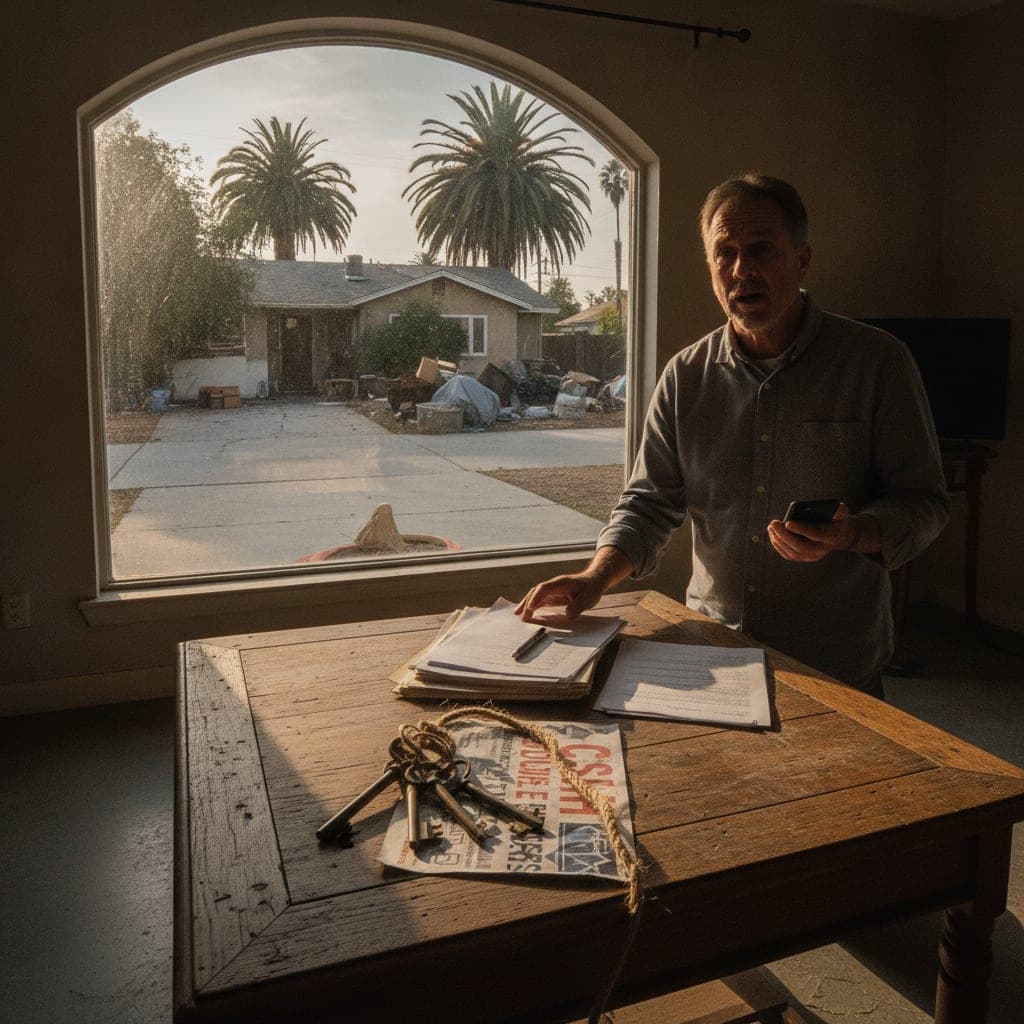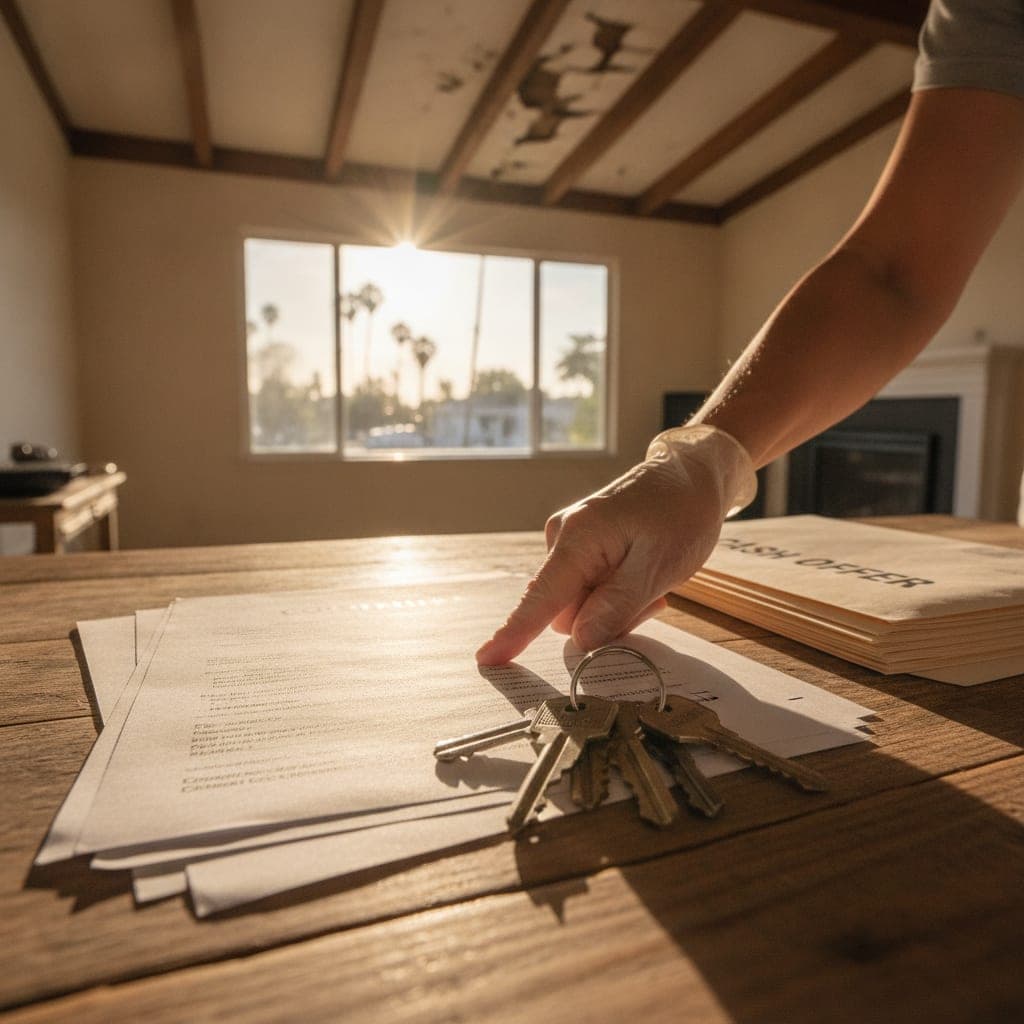

The short answer: some "we buy houses" companies are legit and some run a tight playbook of bait-and-switch tactics that costs sellers tens of thousands. The we-buy-houses ripoff is real, but it is not universal. Most experienced sellers who got burned can name the exact moment they should have walked. This guide lays out the common ripoff patterns, the contract clauses that enable them, and the questions that separate a real California cash buyer from a name on a yard sign.
The honest version of we-buy-houses
A legitimate cash home buyer does what the sign says: they buy houses for cash. They underwrite from comps, factor in repairs, and write a number with the math attached. They put earnest money up. They close on the date in the contract. They do not renegotiate after inspection unless something material was hidden.
The best cash home buyers in California operate this way because the model only works long-term if sellers are satisfied at the closing table. Word travels fast in concentrated SoCal neighborhoods.
A legitimate cash buyer typically pays 70 to 85 percent of after-repair value, closes in 7 to 21 days, charges no fees, and does not try to renegotiate during escrow. If those four boxes are not checked, you are probably not dealing with a real buyer.
The ripoff playbook in five moves
The we-buy-houses ripoff is rarely a single dramatic event. It is a sequence:
- Hook the seller with an above-market initial offer.
- Lock the property up with a long contingency window.
- Use the inspection period to find or invent issues.
- Renegotiate the price down 10 to 25 percent.
- Threaten to walk if the seller resists, knowing the seller has already turned away other buyers.
Each move is legal. Stacked together they extract a discount the seller never agreed to in the first conversation. Recognizing the pattern is the easiest way to stop it.
Move 1: the hot first offer
The seller calls three buyers. Two come back at $480,000 and $495,000. The third comes back at $545,000. The seller signs with the third.
The high offer is the bait. A reputable buyer cannot underwrite a price 10 percent above what comparable cash buyers see in the same property. They are using the same comps and the same repair estimates, the only way to be 10 percent higher is to plan to renegotiate later, or to assign the contract to a different buyer at a lower price.
The defense: if one offer is significantly higher than comparable offers, ask for the buyer's worksheet. "How did you get to this number?" A real buyer will walk you through the comps and the repair list. A bait-offer buyer will deflect.
Move 2: the long contingency window
While the typical reputable cash offer has a 5 to 10 day inspection contingency, the ripoff version often has 14, 21, or even 30 days. The buyer does not need that long to inspect. They need that long to:
- Shop the contract to other investors
- Wait for the seller to commit emotionally and turn away alternatives
- Build a list of "issues" to use as renegotiation leverage
The defense: cap the inspection at 7 days. A real cash buyer can inspect a single-family home in 48 to 72 hours. If they need three weeks, they are not actually planning to close on it themselves.
Move 3: the inspection renegotiation
Day 14 of escrow. The buyer comes back with a four-page list: cracked tile in the second bath, slow drain in the kitchen, an outlet that does not work, a hairline foundation crack. "We are going to need a $40,000 price reduction or we will have to walk."
This is the critical moment. The seller has typically already told a few alternative buyers that the house is sold. They have started planning their next move. They feel locked in.
The defense, before it happens: use a contract that limits price renegotiation to material defects discovered during inspection that were not previously disclosed. A cracked tile is not a material defect. A slow drain is not a material defect. The buyer's negotiation leverage shrinks dramatically when the contract spells out what counts.
The defense, when it happens: ask for the contractor bids supporting the renegotiation amount. "$40,000 for what, specifically?" If the buyer cannot produce documented bids, the renegotiation is fishing. Be willing to walk and re-list.
Move 4: the assignment clause
Somewhere in the contract, often in fine print, sits a clause: "Buyer reserves the right to assign this contract to any third party prior to closing." That is the wholesaler's escape hatch. The buyer never planned to close. They planned to find another investor willing to take their place at a lower price, pocket the difference as an assignment fee, and walk.
If the assignment falls through (no end-buyer materializes), the wholesaler walks and the seller is left holding a vacant property and a 30-day delay. If the assignment succeeds at a lower price than your contract, the wholesaler will renegotiate down to that price and pass the discount through to you.
The defense: strike the assignment clause or limit it to assignment to entities owned by the same parent company. A real cash buyer who actually plans to close has no need for an open assignment right. We cover this in detail on are cash home buyers legit.
Move 5: the closing-day surprise
Day 21. The morning of close. The buyer's title officer calls: "We are seeing some title issues. We need to delay close by two weeks. By the way, we found a few more inspection items. We are going to need another $15,000 off."
The seller has already moved. The seller has already signed a lease at the new place. The seller cannot afford a two-week delay. They take the $15,000 hit.
This is the endgame of the playbook and it is the move that earns the "ripoff" label. The seller's only protection at this point is having structured the contract to make it expensive, for the buyer, to delay or renegotiate. Specifically: a non-refundable deposit that grows with each day past the original close date, a per-diem penalty for buyer-caused delay, and a clean walk-away clause that keeps the deposit if the buyer fails to close.
None of those protections are standard in a generic CAR purchase contract. They have to be negotiated in.
Wholesalers vs. real cash buyers
The single most predictive factor in whether a transaction will go smoothly is whether the buyer actually has the cash they say they have. Wholesalers do not. They have a contract and a Rolodex.
How to tell:
- Real cash buyer: provides bank or escrow proof of funds within 24 hours. The statement shows the company's name, current date, and balance sufficient to close. They will close in their own name, not assign to anyone else.
- Wholesaler: provides "proof of funds" from a transactional-funding provider, or no proof at all. Wants a long inspection window. Wants assignment rights. Talks about "my buyer" as someone separate from themselves.
Wholesaling is legal. It is not inherently a scam. But the seller almost always nets more from a direct sale to the end-buyer than from a wholesale assignment, because the assignment fee comes out of the seller's price. We cover the comparison on vs Opendoor and other iBuyers too, different model, sometimes similar end result.
The 8 questions that vet any buyer
Ask every buyer these eight questions before signing anything:
- Are you the end buyer, or do you plan to assign the contract?
- Can you provide proof of funds dated within the last 7 days?
- What comps did you use to set this offer? Can you send them?
- What repair scope are you assuming? Can you send the line items?
- What is your earnest money deposit, and can it become non-refundable after the inspection contingency?
- What is your inspection contingency window, and can we cap it at 7 days?
- What price-renegotiation language is in your standard contract, and can we limit it to material defects?
- Will the closing agent be a neutral third-party escrow company, and can I choose it?
A reputable buyer will answer all eight clearly and put the answers in writing. A buyer who deflects, slow-rolls, or gives vague answers to any of these is telling you what kind of transaction they are setting up. The same questions work whether you are interviewing a national iBuyer, a local investor, or a "we buy ugly houses" franchise.
Contract clauses to watch for
When you read the buyer's draft contract, look specifically for:
- Assignment rights. As discussed above. Strike or limit.
- Earnest money refund triggers. If the buyer can recover their deposit for any reason during a 30-day window, the deposit is meaningless.
- Inspection-period length. Cap at 7 days. 5 if you have leverage.
- Price-renegotiation language. Should be limited to material defects not previously disclosed, with documented contractor bids required to support any reduction.
- "Subject to financing" clauses. A real cash buyer has no financing contingency. If financing language appears, this is not actually a cash deal.
- Closing-date flexibility. Should be a hard date with seller-favorable per-diem penalties for buyer-caused delays.
- Walk-away clauses. What does the buyer keep if they walk after the inspection period? In a clean contract, they forfeit the entire deposit. In a ripoff contract, they get most of it back.
- Inspection-access language. Some contracts give the buyer unlimited inspection access, allowing them to send a parade of "inspectors" who are actually contractors getting bids for renegotiation. Limit to one inspection visit and one final walkthrough.
This is exactly the kind of language that protects sellers in a California cash sale, and exactly what a reputable buyer will already have built into their standard offer.
Your legal options if it has already happened
If you are mid-escrow with a buyer running this playbook, your immediate options:
- Refuse the renegotiation. Force the buyer to either close at the original price or default. If they default, you keep the earnest money (assuming the contract allows) and re-list.
- Counter-renegotiate. If there is a real defect, get your own contractor bid and counter at a number you can actually defend. "You said $40,000. My licensed plumber bid $4,200 for the drain. I will agree to that."
- Talk to a real estate attorney. Most California real estate attorneys offer a 30-minute consult for $200 to $400. Worth it before you sign anything mid-escrow.
- File a complaint. If the conduct crosses into misrepresentation or fraud, the California Department of Real Estate (DRE) takes complaints. The Better Business Bureau is more useful for reputational pressure than legal recourse but can move a stuck negotiation.
If the deal has already closed at a renegotiated price you feel was extracted under duress, your options narrow. A real estate attorney can review the contract for grounds to unwind, but the bar for rescission after close is high. The lesson is in the prevention, not the cure.
A clean offer, no playbook
If you want to compare what a clean, no-playbook cash offer looks like, written number with the math attached, 7-day inspection, no assignment clause, no inspection renegotiation game, get your offer. 24-hour turnaround. Take it, leave it, or sleep on it. If something feels off, walk. That is the standard you should hold every buyer to. Here is what an honest cash for homes offer looks like.
Common questions
Questions people ask about this
- Are all "we buy houses" companies a scam?
- No. The legitimate ones outnumber the bad actors, but the bad actors are louder. The patterns above are the difference.
- Is HomeVestors / We Buy Ugly Houses a ripoff?
- HomeVestors is a franchise system; the experience varies wildly by individual franchisee. Some are excellent, some run the playbook. Vet the specific franchisee, not the brand.
- Are iBuyers like Opendoor a ripoff?
- Different model. iBuyers do not typically renegotiate after inspection, they charge the discount up front via service fees. The ripoff risk is much lower. The price you net is often comparable to a we-buy-houses outfit once fees come out.
- Should I always list with an agent instead?
- No. For as-is properties, inherited houses, or foreclosure timelines, a cash sale is often the better net outcome. The trick is picking the right cash buyer, not avoiding cash buyers entirely.
- Can I trust a buyer with positive Google reviews?
- Reviews help. Cross-check with the BBB, with the DRE license database, and with the buyer's actual address (drive by it if you can). A real California cash buyer has an office, a license, and a track record longer than 12 months.
Written by
Adrian HernandezCEO/Owner, My Home Sold
Adrian Hernandez founded My Home Sold in 2015 and has led it through more than 900 direct home purchases across Southern California. He has appeared on FOX 11 Good Day LA discussing the shift in the Southern California market and what it means for homeowners whose listings are not moving.
More about AdrianReady to Get Started?
Contact us today to learn how we can help you.