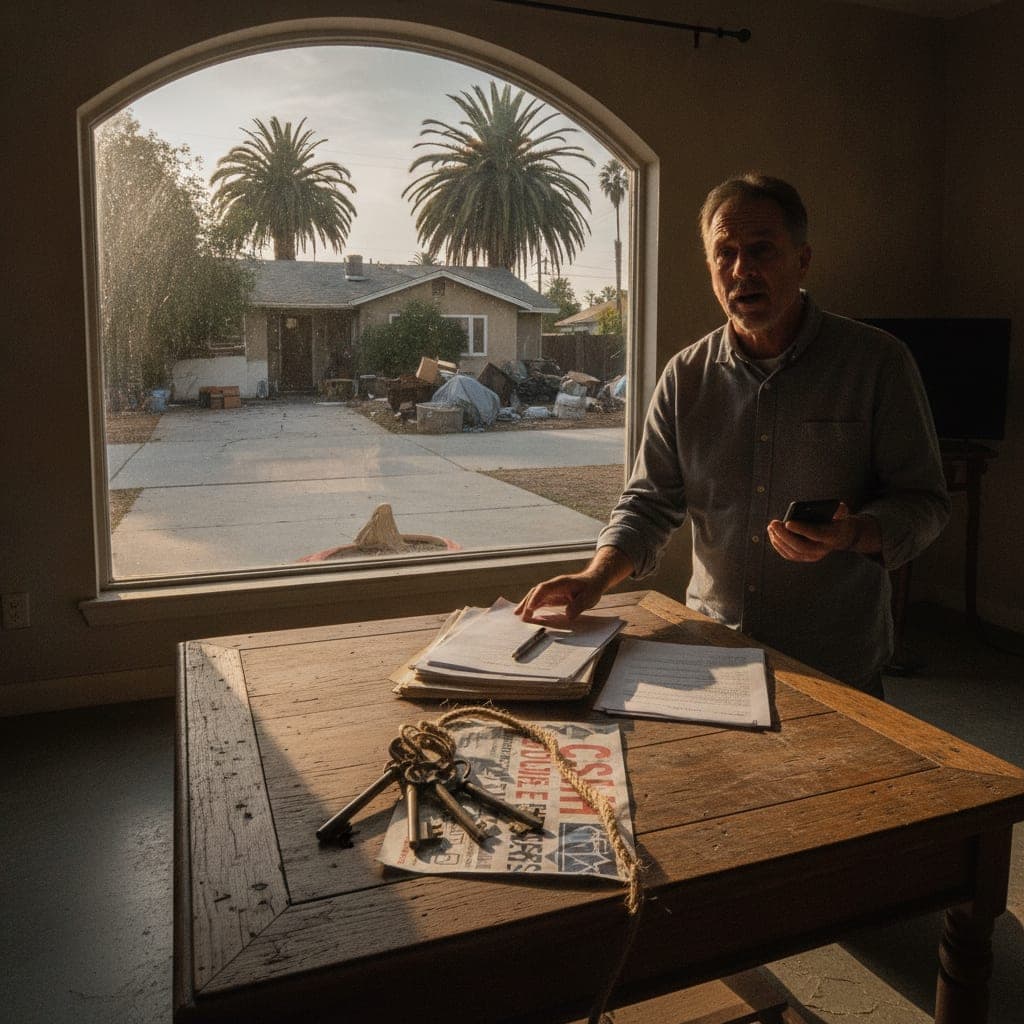
Yes, you can sell house still owing mortgage in California, that is how the vast majority of home sales actually work. The standard California escrow process pays the existing lender off from sale proceeds at the moment the deed records. You do not need to pay your mortgage off in cash before listing. You do not need the lender's blessing to put the house up for sale. The mortgage is simply a lien against the property, and liens get paid at close.
The wrinkles are in three categories: an equity sale (sale price exceeds what you owe, most common), an underwater sale (sale price is less than what you owe, short sale required), and a pre-foreclosure sale (a Notice of Default or Notice of Trustee's Sale has already been recorded, timing matters). This guide walks through all three, plus due-on-sale, multiple liens, HELOCs, and the dollar math on a typical California close.
The short answer
You can sell house still owing mortgage in California in any of the following situations:
- You owe $200,000 and the house is worth $700,000 (equity sale, easy).
- You owe $480,000 and the house is worth $510,000 (thin equity, works, but commissions and closing costs eat the margin).
- You owe $660,000 and the house is worth $625,000 (underwater, short sale process required, lender approval needed).
- You owe $385,000, you are 90 days behind, and a Notice of Default was just recorded (pre-foreclosure, sell before the trustee sale and you keep your equity).
In every one of these scenarios, selling the house before paying off the mortgage is not only allowed, it is the standard way Californians get out of a property they cannot or do not want to keep. The mechanism is the same: escrow collects a payoff statement from your lender, wires the lender their balance at close, and the lender records a reconveyance of the deed of trust under California Civil Code §2941. You walk away with whatever is left.
The mortgage payoff process step-by-step
When you sell house still owing mortgage in California, here is what actually happens between accepting an offer and getting your check:
- Escrow opens. The buyer's earnest money is deposited. Escrow orders a preliminary title report which lists every recorded lien on the property, your first mortgage, any HELOC or second, mechanics liens, judgment liens, tax liens.
- Escrow orders a payoff statement. Your lender produces a written payoff good for typically 30 days, including principal, accrued interest, per diem interest, and any prepayment penalty or recording fees. California lenders usually charge a $30 to $65 statement fee. The per diem matters because every day escrow drags adds to the payoff.
- Buyer's funds arrive. On the day of close, the buyer (or buyer's lender) wires the purchase price to escrow.
- Escrow disburses. Escrow wires the payoff amount plus per diem to your lender, pays off any junior liens in priority order, pays commissions and closing costs, and wires the remainder, your net proceeds, to you.
- Reconveyance recorded. California Civil Code §2941 requires the lender to record a full reconveyance of the deed of trust within 30 days of payoff. That is the document that legally clears the mortgage off title. The buyer's deed records simultaneously or immediately after.
The whole sequence is invisible to you as the seller. You sign the closing package, and a few days later money hits your account and the lender's loan disappears from your credit. There is no separate "pay off the mortgage first" step, that is what escrow is for. For a deeper view of escrow itself, see our California escrow process timeline.
Due-on-sale clause and Garn-St. Germain
Nearly every California mortgage contains a due-on-sale clause: when title transfers, the lender can call the entire loan balance due. This clause is what prevents buyers from quietly "taking over" your loan without lender approval. Federal law, the Garn-St. Germain Depository Institutions Act, 12 U.S.C. §1701j-3, explicitly authorizes lenders to enforce due-on-sale on most residential mortgages.
In a normal sale this is a non-issue, because escrow pays the loan off in full at close, there is no surviving loan balance for the lender to accelerate. The clause matters only if you are trying to leave the existing loan in place after transferring title, which most California sellers are not.
Garn-St. Germain also lists transfers a lender cannot accelerate even though title moves. The big ones in California:
- Transfer to a spouse or child (intra-family).
- Transfer resulting from a divorce decree, legal separation, or property settlement.
- Transfer on death of the borrower to a relative who occupies the property.
- Transfer into an inter vivos (living) trust where the borrower remains a beneficiary.
If you are working through a divorce sale or sorting out an out-of-state inheritance, these exceptions can buy time before a sale becomes mandatory. They do not, however, change the fact that you can simply sell the house and pay the lender off at close, that is always available.
Equity sale: the typical California case
Most California sellers in 2026 are sitting on equity. A homeowner who bought in 2014 in the Inland Empire is typically up well over $200,000. A coastal homeowner who bought before 2018 is often up $300,000 to $500,000. Selling house with mortgage california in this scenario is straightforward:
- Sale price minus existing mortgage payoff minus second-lien payoff (if any) minus commissions minus closing costs minus prorated property tax = your net.
- Escrow handles every disbursement.
- You sign the closing package, the deed records, the reconveyance follows within 30 days under §2941, and your net proceeds wire to your bank.
The one trap is underestimating the mortgage payoff selling house. Your loan statement shows a principal balance, say $312,000. The actual payoff includes accrued interest from the last payment date, per diem interest through the close date, possibly a small prepayment penalty (rare in California after Dodd-Frank), and recording fees. The real payoff is typically $1,500 to $3,500 higher than the statement principal. Plan for it.
A cash buyer will pay slightly less than market but close in 7 to 14 days with no contingencies, which often nets the same or more once you subtract carrying costs, agent commission, and concessions from a traditional listing. The math on that comparison is in our cash offer vs market value California breakdown. A clean equity sale to a cash buyer like My Home Sold is typically the simplest path when speed matters.
Underwater: when the payoff exceeds the sale price
Underwater mortgage california sell scenarios are rarer than they were in 2010, but they still happen, borrowers who took cash-out refis at peak values, neighborhoods hit by specific shocks, or homes with deferred maintenance that drags market value below the mortgage balance.
If the sale price is less than what you owe, you cannot close a normal sale. You need a short sale, which requires the lender to agree to accept less than full payoff and release the lien anyway. The process:
- List the property and accept an offer at fair market value.
- Submit a short sale package to the lender: hardship letter, financial statements, the purchase contract, an estimated HUD-1 showing the shortfall.
- Wait. Lender approval typically takes 60 to 120 days. The buyer has to be patient or willing to wait through it.
- Lender approves a payoff figure. Usually less than the full balance but more than the sale-price-minus-costs.
- Close. Escrow disburses the approved short payoff and the lender records reconveyance.
Two California-specific issues to flag. First, the deficiency, the difference between what you owe and what the lender accepts, may or may not be forgiven. California Code of Civil Procedure §580e prohibits a lender from pursuing a deficiency on a residential property of one to four units after a short sale they approved, which is a meaningful protection. Second, forgiven debt can be cancellation-of-debt income under IRC §108, taxable on your federal return. California has historically conformed to certain federal exclusions but conformity changes, talk to a tax professional before signing the lender's short-sale approval letter.
If you are underwater and also behind on payments, see pre-foreclosure, the timing and short sale paths interact.
Multiple liens and priority order
California escrow pays liens in strict priority order, which is set by recording date (with statutory exceptions for property tax and mechanics liens). The typical order at a California close:
- Property tax liens (super-priority, paid first).
- First mortgage (the original purchase loan).
- Second mortgages and HELOCs (recorded later).
- Mechanics liens (priority depends on when work began vs. when the mortgage recorded).
- Judgment liens (recorded abstracts of judgment).
- Federal and state tax liens (IRS or California FTB).
Every one of these has to be paid or released for title to transfer clean. If a junior lienholder will not accept a partial payoff in a short sale, the deal stops. If you have an IRS lien, see our notes on tax-related sales, the IRS will often subordinate or release a lien to allow a sale, but it takes paperwork and time. Back-tax sales follow a similar pattern with the FTB.
The preliminary title report is where every one of these surfaces. Read it the day escrow opens. Surprises here are the single most common reason a sale falls out.
Pre-foreclosure: NOD, NOTS, and trustee sale
California foreclosure follows the non-judicial trustee sale process under Civil Code §2924 et seq. The timeline:
- Day 0: You miss a payment. Lender starts assessing late fees.
- Day ~120: Lender records a Notice of Default (NOD). This kicks off a minimum 90-day reinstatement window during which you can cure the default by paying the missed amount plus fees.
- Day ~210: If unreinstated, lender records a Notice of Trustee's Sale (NOTS). The sale is set for at least 21 days after the NOTS records.
- Trustee sale day: The property is sold at public auction. Whatever equity you had is largely consumed by fees, and any net surplus goes to junior lienholders before reaching you.
Selling house before paying off mortgage in this window is absolutely possible, and is usually the right move if you have any equity. The earlier the better:
- Before NOD: Cleanest. Standard sale. Credit impact minimized.
- Between NOD and NOTS: Still clean. Lender will accept reinstatement or full payoff at close. You preserve any equity above the payoff plus arrears.
- Between NOTS and trustee sale: Tightest. The 21-day window is real. A traditional listing rarely closes that fast. A cash buyer who can close in 7 to 14 days is often the only realistic option. Equity preserved, credit hit limited, no trustee sale on your record.
- After trustee sale: The house is no longer yours. Equity gone.
If an NOD or NOTS has been recorded against your property, do not wait. The math on selling vs. letting it go to trustee sale almost always favors selling, even at a discount. Our foreclosure situation page walks through the decision tree in more detail. If a job loss is what put you behind, job-loss sales follow the same pattern with extra urgency on cash flow.
HELOCs, second mortgages, and impound refunds
A few smaller items that move real money at close:
- HELOCs and seconds: Pay off in priority order. Make sure the HELOC is fully closed at close, not just paid down, an open HELOC on title is a lien even with a zero balance, and the buyer's title insurer will require it closed.
- Impound (escrow) account refund: If your lender impounds property tax and insurance, the unused balance refunds to you typically 15 to 45 days after payoff. This is real money, often $2,000 to $6,000 in California. Track it.
- PMI refund: If your loan has PMI and you paid an upfront premium within the last few years, a partial refund may be due. Most lenders process this automatically; ask anyway.
- Prepayment penalty: Rare on California residential loans after Dodd-Frank but check the note. A few investor loans and pre-2014 originations still carry them.
- Property tax proration: California taxes are paid in arrears on a fiscal year basis. Escrow prorates them to the close date. You will see a debit or credit depending on where the close date falls.
For the buyer-side closing cost picture, see our breakdown on closing costs for sellers in California.
Worked dollar examples
Four realistic California scenarios for selling house still owing mortgage:
1. Equity sale, Riverside. Sale price $625,000. First mortgage payoff $385,000 (including per diem). HELOC payoff $42,000. Agent commission at 5% = $31,250. Closing costs and prorations $4,000. Net to seller: $162,750. Take the same property to a cash buyer at $585,000 with no commission and seller pays only $1,500 in closing costs: net $156,500, a $6,250 difference for a 12-day close instead of 90 days.
2. Thin equity, Fontana. Sale price $510,000. Mortgage payoff $480,000. Commission at 5% = $25,500. Closing costs $3,500. Net to seller: $1,000. A traditional sale here barely clears. A cash sale at $490,000 with no commission and $1,500 in costs nets $8,500. Counterintuitively, the discounted cash offer wins.
3. Underwater, Hemet, short sale. Sale price $625,000. Mortgage owed $660,000. Lender approves a short payoff of $612,000 (after commissions and costs) and waives the deficiency under CCP §580e. Seller nets $0 but walks away with no deficiency, no foreclosure, and a credit hit of around 100 to 150 points instead of 200+ from foreclosure. Possible IRC §108 cancellation-of-debt income, talk to a tax pro.
4. Pre-foreclosure with equity, Moreno Valley. Sale price $540,000. Mortgage payoff $385,000 + $14,000 in arrears, late fees, and trustee fees = $399,000. NOTS was recorded 11 days ago. A cash buyer closes in 9 days, beating the trustee sale by 1 day. Commission $0, closing costs $1,500. Net to seller: $139,500. If the trustee sale had run, the seller would likely have netted $0 to $30,000 after auction fees and second-lien payoffs, plus a foreclosure on credit for 7 years.
Get a clean number for your situation
If you owe a mortgage and want to know what selling actually nets, equity sale, underwater, or pre-foreclosure, get your offer. We pull the preliminary title, factor in your payoff and any junior liens, and write a number with the math attached. 24-hour turnaround. No obligation. If a traditional listing nets you more, we will tell you. The point is to give you a real number against your real payoff, so you can make the call with the facts in front of you.
Common questions
Questions people ask about this
- Do I have to tell my lender I am selling?
- No. The lender finds out when escrow orders the payoff statement. There is no obligation to notify your lender in advance, and doing so changes nothing about the process.
- Can my lender block the sale?
- No, not in a normal payoff sale. The lender's only interest is being paid in full at close, which is exactly what the standard California escrow process delivers. The only situation where lender consent is required is a short sale (sale below payoff) or a transfer where the existing loan stays in place, neither of which applies to a normal sale.
- How long is a payoff statement good for?
- Typically 30 days. Escrow re-orders if close slips past the expiration. Most California lenders also list a per diem interest figure so escrow can compute a current payoff for any close date within the window without re-ordering.
- Will I owe taxes on the equity I take out?
- Maybe. Federal capital gains exclusion is up to $250,000 single / $500,000 married for a primary residence under IRC §121, provided you owned and occupied it for 2 of the last 5 years. California conforms. Investment property and second homes do not qualify. See our capital gains breakdown for the timing tradeoffs.
- What if I have a reverse mortgage?
- Reverse mortgages still get paid off from sale proceeds at close. The payoff is the loan balance plus accrued interest plus any servicing fees, often a much larger number than a forward mortgage on the same property because of compounded interest. Order the payoff statement early; reverse mortgage servicers can be slow.
- Can I sell to a family member while keeping the loan in place?
- Garn-St. Germain (12 U.S.C. §1701j-3) lets a transfer to a spouse or child happen without triggering due-on-sale. The loan stays in your name unless your relative qualifies for and assumes it. This is an estate-planning move, not a clean sale. Talk to an attorney before structuring it.
Written by
Adrian HernandezCEO/Owner, My Home Sold
Adrian Hernandez founded My Home Sold in 2015 and has led it through more than 900 direct home purchases across Southern California. He has appeared on FOX 11 Good Day LA discussing the shift in the Southern California market and what it means for homeowners whose listings are not moving.
More about AdrianReady to Get Started?
Contact us today to learn how we can help you.