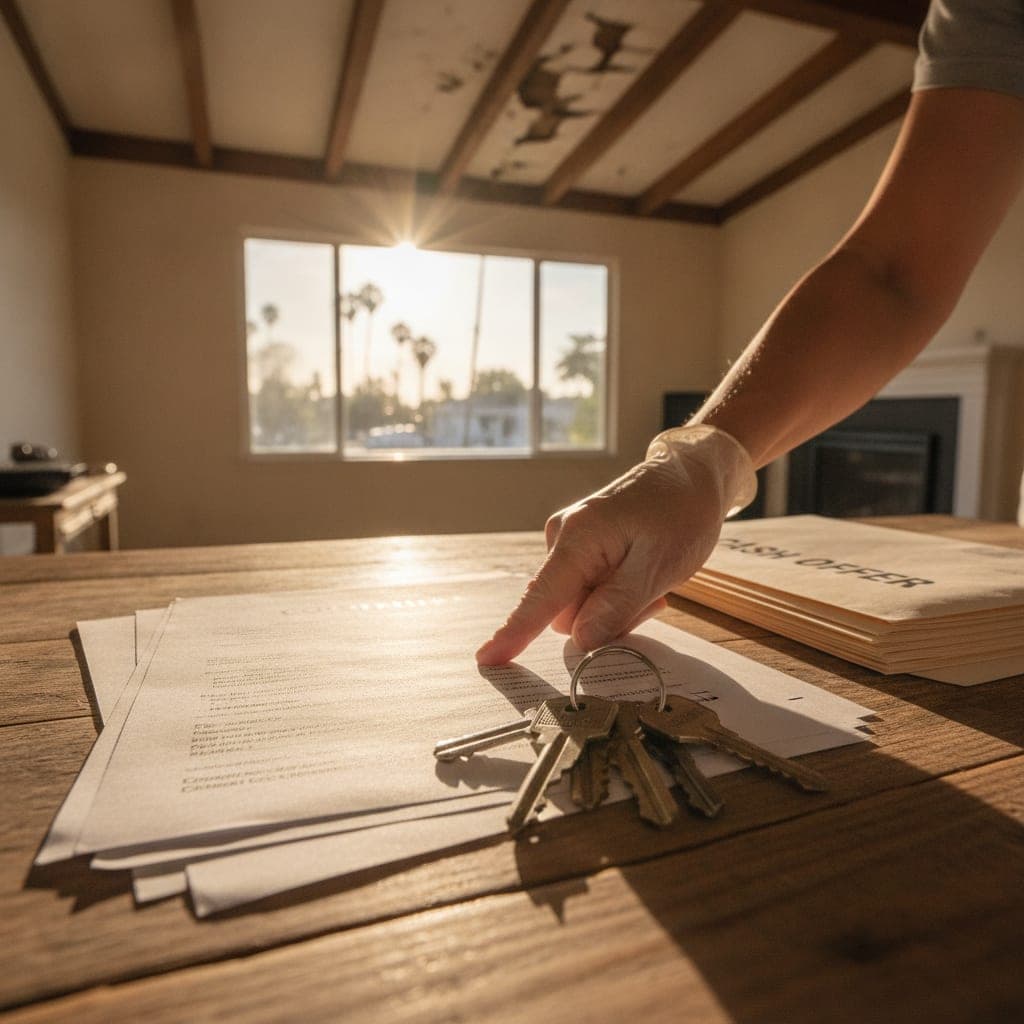

The short answer: yes, you can sell a house as-is without inspection in California. There is no California statute that requires a buyer to inspect a property before purchasing it, and on cash deals buyers waive the inspection contingency every day. What California does require, regardless of whether the buyer ever sets foot in the house with a flashlight, is statutory disclosure. The Transfer Disclosure Statement, the Natural Hazard Disclosure, AB-38 in fire zones, lead-based paint disclosure on pre-1978 homes, and the Megan's Law notice are not waivable. So can you sell a house as-is without inspection? Yes. Can you sell one without disclosing what you know? No. This guide separates the two.
The direct answer: yes, with one caveat
Can you sell a house as-is without inspection in California? Yes. The state does not mandate a buyer's home inspection. The California Association of Realtors Residential Purchase Agreement (CAR RPA) includes an inspection contingency by default, but it is a contractual right that belongs to the buyer, and the buyer is free to waive it. On a cash deal between a motivated seller and an experienced investor, the inspection contingency is waived in writing more often than not.
The one caveat: waiving inspection does not waive disclosure. California Civil Code §1102 and §1103 require the seller to deliver a written Transfer Disclosure Statement (TDS) and Natural Hazard Disclosure (NHD) for almost every residential transaction, including as-is sales and cash sales. Selling a house as-is without inspection is legal. Selling a house without statutory disclosure is not. The two questions get conflated constantly, which is how sellers end up in court two years after closing.
The "as-is" myth
A lot of California sellers think "as-is" is a magic phrase that makes the house someone else's problem the moment escrow closes. It is not. Under California law, an as-is clause does two specific things and nothing more:
- It waives the implied warranty of habitability for the property's existing condition.
- It puts the buyer on notice that the seller will not make repairs as a condition of the sale.
What as-is does not do:
- It does not relieve the seller of the duty to disclose known material defects under Civil Code §1102.
- It does not bar the buyer from later suing for fraud if the seller hid a known issue.
- It does not waive the buyer's right to inspect, that is a separate contract term.
- It does not eliminate AB-38 (defensible space and home hardening) obligations in high or very high fire severity zones.
The legitimate use of as-is is exactly what it sounds like: the seller is not going to fix the cracked stucco, the dated kitchen, or the slow drain, and the price reflects that. The legitimate use is not "I do not have to tell you about the foundation crack I patched last spring." That is fraud, regardless of how many times the contract says "as-is." Our we-buy-houses-as-is page walks through what a real as-is offer looks like.
Buyer inspection vs. seller pre-inspection
Two different things, often conflated:
- Buyer's inspection. Performed during escrow by an inspector the buyer hires. Triggers the inspection contingency. Can be waived. This is what people usually mean when they ask "can you sell a house as-is without inspection."
- Seller's pre-inspection. Performed before listing by an inspector the seller hires. Discloses the report to buyers up front. Not required. Some sellers do this to reduce renegotiation risk; others skip it deliberately on a cash sale because the buyer is going to discount for assumed condition anyway.
A cash buyer who is paying 70 to 85 percent of after-repair value is already pricing the property as if it has every common issue a 30-year-old California home tends to have. A pre-inspection rarely changes that number. So if you are working with a serious cash buyer, skipping pre-inspection is fine. If you are working with a retail buyer who is going to base their offer on a clean walk-through, a pre-inspection can be useful, but at that point you are not really running an as-is, no-inspection sale.
The CAR RPA inspection contingency and how it gets waived
The CAR RPA gives the buyer a default 17-day investigation period covering inspections, appraisal, loan, title, and disclosure review. During those 17 days the buyer can cancel for almost any reason and recover the earnest money deposit. Sellers who want to sell a house as-is without inspection have three options inside the standard contract:
- Counter the contingency period down. Offer a 5-day inspection window instead of 17. A serious cash buyer can complete an inspection in 48 hours.
- Require the buyer to waive the inspection contingency at the time of offer. This is standard on cash deals where the buyer has already walked the property. The contract is signed with no inspection contingency at all.
- Make the earnest money non-refundable after a short window. Even if the contingency stays in, a non-refundable deposit after day 3 or day 5 sharply limits how the buyer can use the contingency to renegotiate. We covered this dynamic in detail on the we-buy-houses ripoff guide.
When sellers ask "can you sell a house as-is without inspection," what they usually mean is option 2, a clean cash deal with no inspection contingency. That is legal, common, and how most experienced California cash buyers structure offers. Just make sure the waiver is in writing inside the purchase agreement, not a verbal promise.
Why financed buyers cannot really skip inspection
If you want to sell a house as-is without inspection, you are almost certainly looking for a cash buyer. Here is why a financed buyer effectively cannot waive inspection even when they say they will:
- The lender's appraisal functions as a partial inspection. FHA, VA, and most conventional loans require the appraiser to flag obvious safety and habitability issues, bare wiring, missing handrails, broken windows, roof issues. If the appraiser flags any of those, the loan does not fund until they are fixed.
- Lender repair conditions are non-negotiable. A buyer who waived their personal inspection contingency still cannot close if the lender refuses to fund. The seller is stuck either making the repairs or losing the deal.
- Loan contingencies stay in. Even with inspection waived, the financing contingency typically runs 21 days. If the lender pulls out for any inspection-adjacent reason, the buyer recovers the deposit.
So when sellers want to genuinely sell a house as-is without inspection, the practical move is a cash buyer. Our cash offer process is built around exactly this scenario: no inspection contingency, no lender, no appraisal, no financing escape hatch.
Worked example: a $580,000 San Bernardino home
A seller in San Bernardino inherits a 1968 ranch home from a parent. The home has deferred maintenance, original kitchen, original bathrooms, a roof that is 19 years old, some foundation settling that is cosmetic but visible. After-repair value is $580,000. The seller has two paths.
Path A: traditional sale with full buyer inspection.
- List price: $475,000 (priced for condition)
- Buyer offer: $470,000 with 17-day inspection contingency
- Inspection comes back with $42,000 of itemized issues (roof, two HVAC components, kitchen GFCIs, water heater)
- Buyer renegotiates to $440,000 or seller credits $30,000 in escrow
- Seller agent commission: $13,200
- Buyer agent commission: $13,200
- Net to seller: roughly $383,600 after commissions and a $30,000 credit, before closing costs
- Timeline: 45 to 60 days
Path B: cash sale, as-is, no inspection contingency.
- Cash offer: $415,000
- No inspection contingency, no financing contingency, no appraisal
- No commissions, no repair credits, no closing-cost concessions
- Seller pays standard escrow and title fees: roughly $4,500
- Net to seller: roughly $410,500
- Timeline: 10 to 14 days
The gap between the two paths in this scenario is about $26,900, and Path A still carries renegotiation risk that Path B has eliminated. The math is property-specific (we go through it generally on cash offer vs. market value), but the structure is consistent: when you sell a house as-is without inspection to a cash buyer, you trade a discount for certainty and speed. For an inherited house or a vacant property carrying monthly costs, that trade often nets out positive.
The five disclosures you cannot skip
Even when you sell a house as-is without inspection, California law still requires the following disclosures. Skipping any of them creates personal liability that survives the sale by years.
- Transfer Disclosure Statement (TDS). Required by Civil Code §1102. Covers known material defects, system conditions, hazards, and prior repairs. Not waivable on most residential sales of 1-4 units. The exception list is narrow (probate sales, court-ordered transfers, transfers between co-owners) and most as-is cash sales are not exempt.
- Natural Hazard Disclosure (NHD). Required by Civil Code §1103. Covers FEMA flood zones, very high fire severity zones, earthquake fault zones, seismic hazard zones, and dam inundation areas. Almost every California seller orders this from a third-party NHD provider for $75 to $125.
- AB-38 fire-zone disclosure. For homes in high or very high fire hazard severity zones, AB-38 requires a written list of features that make the home vulnerable to wildfire and a defensible space inspection on homes built before 2010. As-is does not waive this.
- Lead-based paint disclosure (federal). Required for any home built before 1978. Federal Title X. Even on a cash as-is sale.
- Megan's Law notice. A specific paragraph (typically embedded in the purchase agreement) directing the buyer to the California Department of Justice sex offender registry. Required statewide.
For a deeper walk-through of TDS and NHD specifically, what each form asks, what "known" means, and what the safe disclosure standard looks like, see our seller disclosures guide. A serious cash buyer will not only accept these disclosures, they will hand you the exact forms and walk you through them.
The actual risk of skipping inspection
The risk profile of selling without inspection depends entirely on who is on the other side of the table.
In a clean cash deal: essentially zero risk to the seller. The buyer has walked the property, priced for condition, signed a purchase agreement with the inspection contingency waived, and posted earnest money. They cannot come back and renegotiate based on something they discover after closing, they took the property as-is. Your only exposure is post-closing fraud claims, which require the buyer to prove you actively concealed a known material defect. Honest disclosure on the TDS eliminates that risk.
In a low-ball middleman deal: meaningful risk. Some "cash" buyers take the contract with the inspection contingency in place specifically to renegotiate during the contingency window, they call it inspection but they are really running a due-diligence renegotiation playbook. The defense is the same in either case: short contingency window, non-refundable deposit, no assignment rights, and a buyer who is willing to put proof of funds in writing. We cover the broader vetting framework on are cash home buyers legit and the speed-of-sale playbook on how to sell my house fast in California.
If you are in a true time-crunch, pre-foreclosure, code violations, title issues, selling as-is without inspection to a serious cash buyer is usually the right call. The certainty matters more than the last 5 to 8 percent of price.
A clean as-is offer, no inspection drama
If you want to see what an as-is, no-inspection cash offer actually looks like on your specific California property, written number, full statutory disclosures handled, no inspection contingency, no financing contingency, 7 to 14 day close, get your offer. 24-hour turnaround. Take it, leave it, or sleep on it. Selling a house as-is without inspection is the most common structure we run, and it is built into our we-buy-houses-as-is process from offer through close.
Common questions
Questions people ask about this
- Can you sell a house as-is without inspection in California legally?
- Yes. California has no statute requiring a buyer's inspection. The inspection contingency in the standard CAR RPA is contractual and can be waived in writing. Statutory disclosure obligations under Civil Code §1102 and §1103 still apply.
- Does "as-is" mean I do not have to disclose anything?
- No. As-is waives implied warranties and signals no repairs will be made. It does not waive the Transfer Disclosure Statement, the Natural Hazard Disclosure, AB-38, lead-based paint disclosure, or Megan's Law notice. Hiding a known material defect is fraud regardless of as-is language.
- Will a cash buyer require an inspection?
- Most serious California cash buyers do their own walk-through and waive the formal inspection contingency. Some will run a quick inspection inside a 3 to 5 day window for their own underwriting but commit to no price renegotiation. The waiver should be written into the purchase agreement, not a verbal promise.
- Can I skip inspection on a financed buyer's offer?
- In theory yes, in practice no. The lender's appraiser will flag obvious safety issues and the lender will require repairs before funding. Your only realistic path to a no-inspection sale is a cash buyer.
- What if the buyer finds something after closing?
- In an as-is, no-inspection sale, the buyer assumed condition risk for anything that was disclosed or that they could have discovered. Their only recovery is for actively concealed known defects, fraud, in other words. If you completed an honest TDS, that risk is minimal.
- Is the inspection contingency the same as the financing contingency?
- No. They are separate contingencies in the CAR RPA. Even if a buyer waives inspection, a financed buyer still has loan and appraisal contingencies that can pull the deal apart. Cash buyers waive all three.
Written by
Adrian HernandezCEO/Owner, My Home Sold
Adrian Hernandez founded My Home Sold in 2015 and has led it through more than 900 direct home purchases across Southern California. He has appeared on FOX 11 Good Day LA discussing the shift in the Southern California market and what it means for homeowners whose listings are not moving.
More about AdrianReady to Get Started?
Contact us today to learn how we can help you.